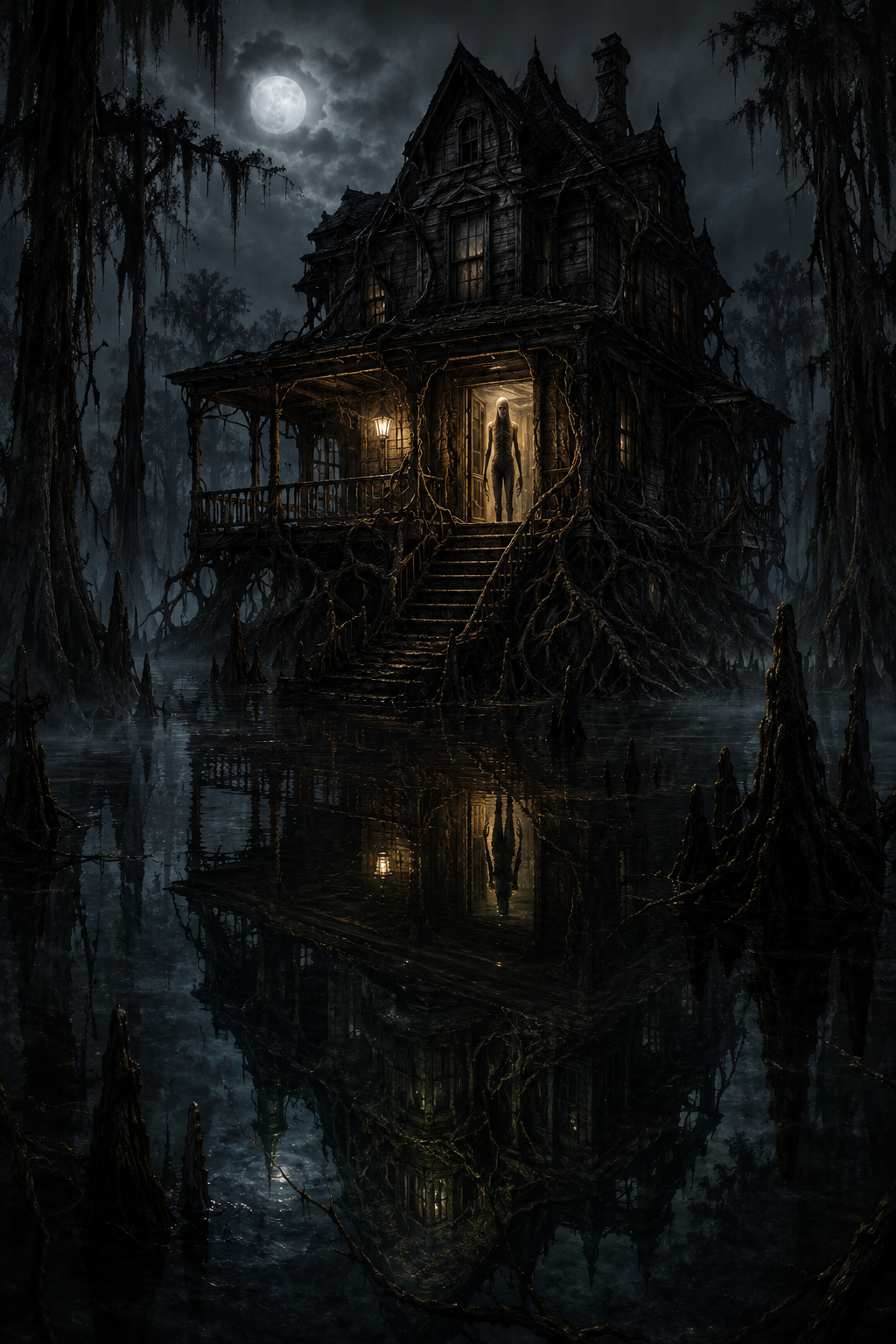
A Swamp Monkey Legend
The first man to enter the house drowned in a dry room.
His name was Thomas Arlen, though nearly everyone in Blackwater Parish called him Tom. He had worked salvage jobs from Toledo Bend to the Gulf, recovering sunken boats, lost equipment, stolen guns, and the occasional body nobody else wanted to touch.
He did not believe in haunted water.
Water concealed things.
It preserved things.
It moved things farther than people expected.
Those facts frightened men who preferred stories, but Tom had spent twenty seven years underwater and never seen a ghost.
He had seen bodies standing upright in submerged vehicles because seat belts held them in place. He had seen catfish nesting inside human rib cages. He had seen drowned men open their mouths when pressure changed during recovery.
Every one of those things had an explanation.
That was why Silas Creed hired him.
The fisherman who reported Camp Nine’s roof had been drinking. Silas admitted that before Tom finished unloading his tanks.
The man claimed he had been running a trotline through the old Mercer basin when his hook caught metal. He pulled until a section of rusted roof broke the surface.
Then a light came on beneath him.
Not sunlight reflecting from the water.
A lantern.
The fisherman cut his line, abandoned six hooks, and drove home.
Silas believed the roof.
He did not believe the lantern.
Tom believed neither until the sonar painted a building beneath the boat.
He leaned over the display.
The old camp had supposedly collapsed years earlier, sinking into mud and black water. What appeared on the sonar did not look collapsed.
Four walls.
A sloping roof.
A porch.
Upright pilings disappearing into the basin floor.
Silas stood behind him in a white buttoned shirt with the sleeves rolled neatly to his forearms.
“What do you think?”
Tom checked the image again.
“I think your fisherman had more than beer.”
“But it is there.”
“Something is there.”
“Camp Nine.”
“Buildings do not reassemble after sinking.”
Silas smiled.
“You see why I hired you.”
Tom looked toward the water.
The basin was still despite wind in the trees.
Cypress branches moved above them, but no ripples crossed the black surface.
Around the edge of the flooded site lay objects that did not belong together.
A section of concrete culvert.
Two rusted engine blocks.
A fallen pine trunk.
A deer carcass swollen with decay.
A broken safe.
All had been pushed or dragged toward the water.
Tom pointed.
“Your crew dump that?”
Silas glanced over.
“No.”
“County cleanup?”
“No.”
“Then who?”
Silas looked toward the trees.
“Local wildlife.”
Tom laughed.
“Wildlife moved a diesel engine?”
“Blackwater animals are unusually industrious.”
Tom began preparing his equipment.
He checked his air supply, camera feed, lights, emergency tank, knife, and line twice. He mounted the communication unit against the side of his helmet.
Silas sat beneath the boat canopy with the monitor.
“You have audio?”
Tom tapped the helmet.
“Try not to breathe into your microphone like a midnight caller.”
Silas’s voice came through the speaker.
“Professional as ever.”
Tom entered backward.
The water closed over him.
At five feet, daylight became green.
At ten, gray.
At fifteen, black.
His lights found particles suspended in the basin. Wood fragments. Moss. Pale strands of root. They drifted without current.
The roof appeared beneath him.
Metal sheets ran cleanly from ridge to edge.
Not crushed.
Not broken.
Moss grew across parts of it, yet the structure looked newly assembled.
Tom descended beside the porch.
The front steps vanished into mud.
A wooden sign hung above the door.
MERCER AND SONS
The letters were swollen but readable.
A lantern glowed through the window.
Tom stopped kicking.
The yellow flame moved behind dry glass.
“Silas.”
“I see it.”
“There is fire inside.”
“Electrical?”
“Under twenty feet of water?”
“Chemical light?”
“It is a lantern.”
Tom approached the window.
Curtains moved within the room.
Not floating.
Hanging.
He touched the glass.
The pane was warm.
His camera feed flickered.
Silas’s voice broke into static.
“Tom, reading interference.”
“I am going inside.”
“Wait.”
Tom tried the front door.
It opened inward.
Black water poured across the threshold around him.
He moved through.
The moment his helmet crossed the doorway, the water vanished.
Not drained.
Gone.
Tom fell forward onto dry floorboards.
His tank struck the doorframe.
Water streamed from his suit, forming a puddle beneath him.
He turned.
Beyond the open doorway, the swamp remained submerged. Black water stood like a vertical wall across the entrance.
A fish swam past.
Tom reached toward it.
His glove crossed the threshold and entered water.
He pulled back.
Dry room.
Submerged exterior.
Impossible.
“Silas?”
Static.
The lantern rested on a table.
Its flame burned normally.
The main room resembled an old hunting camp.
Four bunks.
A wood stove.
Shelves.
A desk in the far corner.
Mud coated the ceiling in a thick uneven layer.
Roots emerged from it and hung downward like vines.
The furniture had been bolted overhead.
A chair hung upside down above the table.
A metal cabinet clung to the ceiling with its doors open.
Tom looked at the floor.
Bare boards.
Dry.
“Silas, I am inside.”
His voice echoed strangely.
A second Tom whispered beneath him.
“I am inside.”
He stopped.
Footsteps moved below the floor.
One step beneath his left boot.
Another beneath his right.
Tom shifted his weight.
The footsteps copied him.
He lifted one foot.
Below, something lifted its own.
He set it down.
The board flexed upward.
Not beneath his weight.
Against it.
Tom backed toward the door.
A shape pressed beneath the wood.
Long fingers outlined under the planks.
A hand rising from below.
In the center of the palm, a human face pushed against the grain.
Eyes closed.
Mouth open.
The face was Tom’s.
He stumbled.
The floor hand followed.
Boards bent upward without breaking.
His own face turned beneath them.
Its eyes opened.
Tom ran toward the door.
The room stretched.
The entrance moved farther away.
Ten feet.
Twenty.
The camp had not been that long from outside.
The lantern behind him went out.
A door opened in the wall to his right.
Warm light spilled from within.
Tom heard his wife singing.
She had been dead eight years.
“Thomas?”
He kept running.
The submerged doorway remained ahead, impossibly distant.
The floor rose beneath his boots.
His copied footsteps became faster than his own.
His wife called again.
“Thomas, come help me.”
The wall beside him split.
A root wrapped around his air hose.
Tom cut it.
Black fluid spilled across the floor.
Every room in the house screamed.
His helmet feed froze on one final image.
The floor had opened beneath him.
A vast hand made of roots and old wood reached upward.
Within its palm were dozens of human faces.
Tom’s was only the newest.
Silas watched the screen go dark.
The communication line tightened once.
Then went slack.
Tom Arlen’s body surfaced three days later, seven miles east of the basin.
His lungs contained no water.
His suit was dry.
The skin across his chest, arms, and face carried a dark repeating pattern.
Not bruising.
Not cuts.
Wood grain.
The parish medical examiner called it pressure marking.
Sheriff Lenora Pike called it another reason to leave Camp Nine buried.
June Vick called it proof.
She first saw Tom’s final image on a Tuesday morning inside the back room of the Highway 17 gas station.
Mavis had once stored bait, cleaning supplies, and old records there. After Mavis died, the new owners rented the room to June for a dollar a year and the promise that she would stop stacking evidence boxes in their drink cooler.
June had converted it into an archive.
Metal shelves lined the walls.
Each bore a handwritten label.
LOWLAND MAN
DEAD MAN SLOUGH
BELL TREES
CYPRESS KNOCK
BLACKWATER TRACKS
MERCER FILES
UNCONFIRMED SIGHTINGS
The Official Swamp Monkey Research Division emblem hung above the desk.
A crouched figure between two cypress trees.
Tourists bought the symbol on shirts and hats in the room beyond the wall.
June catalogued the stories that made it a warning.
At twenty three, she had spent nearly a quarter of her life organizing the things adults had once denied.
Photographs.
Cassette tapes.
Audio files.
Witness statements.
Hair samples.
Broken tools.
Maps drawn by men who later disappeared.
The work began after Noah’s rescue from Dead Man Slough.
At first, she collected records because nobody else would.
Then because memory changed.
People softened details.
Removed themselves from blame.
Forgot dates.
Turned terror into entertainment.
June believed evidence was the only thing that did not get tired of telling the truth.
Noah disagreed.
He stood across the archive table while Tom Arlen’s frozen video image filled June’s monitor.
The submerged camp waited behind the diver.
A glowing lantern.
Dry curtains.
The outline of a face beneath the floor.
Noah looked away first.
“Delete it.”
June paused the footage.
“That is not how archives work.”
“That is how traps work.”
“It is evidence.”
“It is bait.”
“Evidence can be both.”
“Then why keep it?”
“Because knowing the bait exists helps people avoid it.”
Noah laughed without humor.
“Did it help Tom?”
“He went in before we had the footage.”
“And the next person?”
“There should not be a next person.”
“There will be.”
June removed the memory drive.
Noah watched her place it inside an evidence sleeve.
He was twenty five now.
Older than her by two years, though Dead Man Slough had aged him in ways that never appeared on a calendar.
He had moved to Houston after finishing school.
Found work repairing commercial air systems.
Built a life where nobody knew his father had nearly killed him, nobody had seen bodies walking out of black water, and nobody used the words Swamp Monkey unless discussing novelty shirts.
He returned to Blackwater for family birthdays, holidays, and emergencies June rarely admitted were emergencies.
Tom Arlen’s death brought him back.
“You called me because you knew Silas was going after the camp,” Noah said.
“I called because he wants access to our records.”
“Say no.”
“I did.”
“And?”
“He already copied part of the Mercer map before Mavis died.”
Noah stared at her.
“How?”
“I do not know.”
“You keep everything in one room with a cash register on the other side of the wall.”
“The room locks.”
“So did Dad’s jail cell.”
June’s jaw tightened.
Their father had drowned in a dry cell with black water in his lungs.
Neither spoke his name often.
Noah softened slightly.
“June, leave Camp Nine alone.”
“I have.”
“You made an entire shelf for it.”
“I made shelves for things that happened.”
“That is not leaving anything alone.”
June turned back to the monitor.
The final frame showed the hand beneath the floor.
She enlarged it.
Faces pressed through the palm.
Tom.
Franklin Mercer.
A young man who might have been Gideon.
Amos Bell.
One she did not recognize.
The wood grain around them formed lines similar to roots in photographs from Dead Man Slough.
Noah saw it.
“No.”
“You see the connection.”
“I see your face when you think horror has given you a puzzle.”
“It is connected.”
“So what?”
“So Camp Nine was rebuilt using the same root tissue beneath the slough.”
“And what does knowing that do?”
“It tells us where it came from.”
“Or tells it how to keep you looking.”
June faced him.
“Why did you come?”
“Because you asked.”
“No. Why did you actually come?”
Noah looked toward the archive shelves.
“Because every time something wakes up in this parish, you stand closer.”
June did not answer.
A delivery truck stopped outside.
The front bell chimed.
Someone laughed near the merchandise wall.
Normal life pressed thinly against the room.
Noah picked up a black Research Division shirt from a box.
The crouched figure appeared between the trees.
“You know what I think this means?” he asked.
“A boundary mark.”
“That is what Franklin thought.”
“Family sign, then.”
“That is what Amos thought.”
“What do you think?”
Noah folded the shirt.
“I think every person who studies it decides it means whatever gets them to walk farther.”
He placed it on the table.
The floor beneath them knocked once.
June and Noah stopped.
The sound came from below the concrete foundation.
A second knock followed near the back wall.
The front of the store remained noisy.
Customers talking.
Coolers humming.
Nobody else reacted.
A third knock came from inside the evidence cabinet marked CAMP NINE.
Noah stepped away.
June unlocked the cabinet.
“Do not,” he said.
She opened it.
A brass key lay on the top shelf.
Wet.
Black water collected beneath it.
The key had not been there the night before.
A paper tag hung from the ring.
CAMP NINE
The handwriting belonged to June.
She had never written it.
That night she dreamed of a door.
It stood at the end of her hallway where no door had ever been.
The wood was swollen and dark.
Water seeped beneath it, spreading across the floor without making the boards wet.
June approached.
From behind the door came the sound of furniture moving.
Chair legs scraping.
A table dragged into position.
A bed frame assembled one iron piece at a time.
She touched the knob.
The hallway disappeared.
She stood beneath black water.
Her house hung above her, upside down.
Windows glowed.
Curtains moved.
Every room was occupied by people she knew.
Franklin Mercer sat at her kitchen table.
Amos Bell stood beside her bed.
Caleb Ward walked her hallway in muddy boots.
Wade Mercer waited at the back door.
Eli crouched beneath the stairs with his arms too long and his eyes reflecting amber.
Noah stood in the living room.
He pounded against the glass.
June swam toward him.
The house receded.
A voice spoke behind her.
“The house did not escape the swamp.”
June turned.
A pale figure stood on the bottom.
Small.
Folded.
Long arms wrapped around its knees.
Where its mouth should have been was the impression of a bare human foot.
The voice continued from inside the footprint.
“It learned how to be remembered somewhere else.”
June woke standing in her hallway.
Her hand rested against the wall.
Three wet boards had appeared beneath her feet.
They were older than the rest of the floor.
Dark.
Warped.
Smelling of black water.
She did not tell Noah.
Silas Creed arrived at the archive the next morning.
He wore a charcoal suit despite the heat and carried no umbrella in the rain.
Silas was fifty, silver haired, and too calm to be trusted easily. He owned Creed Recovery and Historical Salvage, a company that recovered Civil War weapons, shipwreck cargo, lost industrial equipment, and anything else capable of being converted into a documentary contract.
His public argument was that hidden history benefited nobody.
His private argument was that recovered history belonged to the person who paid to retrieve it.
June disliked him before he spoke.
“Ms. Vick.”
“Mr. Creed.”
“I am sorry about Tom.”
“You sent him into the camp.”
“He volunteered for paid work.”
“He did not volunteer to drown on dry boards.”
Silas glanced toward Noah.
“Mr. Vick.”
Noah remained near the door.
“Leave.”
Silas smiled.
“You share your sister’s hospitality.”
“We share a dislike for scavengers.”
“I recover what others abandon.”
“People abandon land mines too.”
Silas placed a waterproof case on the table.
Inside lay a section of wooden molding.
Dark wood.
Hand carved.
June recognized it from photographs of Camp Nine’s office.
A line of black water ran across its surface despite the case being dry.
“Where did you find that?” she asked.
“Four miles from the basin. Resting on a road after the last storm.”
“It was not washed there.”
“No flood crossed that road.”
Silas opened a second compartment.
A photograph.
Franklin, Gideon, and Ralph outside Camp Nine.
Official Swamp Monkey Research Division shirts.
The same image existed in June’s archive, but this copy differed.
A fourth person stood at the edge.
A young woman.
June.
Not merely someone resembling her.
June in the clothes she wore that morning.
She stood behind Franklin, one hand resting on his shoulder.
On the back, in black ink, someone had written:
LAST COMPLETE PHOTOGRAPH
OCTOBER 12, 1978
JUNE CAME LATER
Noah read it.
His face went pale.
Silas watched them.
“I believe the structure is producing objects.”
“Copies,” June said.
“Perhaps.”
“Made from what?”
“That is why I need your records.”
Noah closed the case.
“You need to leave.”
Silas ignored him.
“The parish granted a limited recovery permit.”
Lenora entered through the back door.
“No, it did not.”
Silas turned.
Lenora had retired from the sheriff’s office, but retirement had not removed authority from her voice.
He offered the same pleasant smile.
“The state owns the submerged basin.”
“The access road crosses private parcels.”
“We have easements.”
“You have paper.”
Silas looked at June.
“Camp Nine is resurfacing. We can recover it carefully, or someone without our equipment will tear it apart.”
“Leave it underwater,” Noah said.
Silas’s expression sharpened.
“That approach has worked wonderfully so far.”
June looked at the molding.
Her fingers wanted to touch it.
Evidence.
A real object from a structure that should not exist.
Noah noticed.
“Do not.”
Silas opened the case fully.
“I have sonar, pumps, cranes, structural engineers, remote vehicles, and a full environmental containment system.”
“You have money,” Lenora said.
“Yes.”
“You think that is another word for permission.”
“It often becomes one.”
June asked, “What do you want from me?”
Noah swore.
Silas answered immediately.
“Site identification. Historic floor plan. Known hazards. Access to Mercer maps and the original Research Division records.”
“No samples leave Blackwater Parish.”
“Negotiable.”
“No public release without review.”
“Negotiable.”
“No creature hunting.”
Silas’s smile returned.
“I am interested in architecture.”
Lenora looked at June.
“You already decided before he walked in.”
“No.”
“You are naming terms.”
June stared at the impossible photograph.
“If we do nothing, the house keeps producing objects.”
Noah stepped between her and the case.
“If we go, it produces people.”
Silas closed the lid.
“The operation begins Monday.”
“Then why ask?” Noah said.
“Because I prefer cooperation.”
He left the case.
“A gesture of trust.”
When he was gone, Lenora opened it again.
She studied the photograph.
“Burn it.”
June looked at her.
“You kept Martin Greaves’s picture for years.”
“And learned what?”
“That the dead were being copied.”
“After how many died?”
Noah looked at June.
“This is the part before the part where you say nobody could have known.”
June touched the edge of the photograph.
The paper was warm.
A room appeared inside her head.
Franklin’s office.
The smell of coffee and wet wool.
A floorboard knocking beneath his chair.
She pulled her hand away.
“What happened?” Lenora asked.
“Nothing.”
Noah saw the lie.
“You felt something.”
June placed the photograph back.
“The objects carry impressions.”
“Memories?”
“Maybe.”
“Whose?”
June looked toward the locked shelves.
“Everyone who stayed there.”
Silas’s recovery site spread across three acres by the following week.
Crews widened the road, built a pumping platform, installed temporary lighting, and floated barriers across the basin.
Two cranes stood beside the water.
Industrial pumps drew black water into containment tanks.
The basin level fell six inches the first day.
One foot the second.
On the third morning, the roof appeared.
Workers stopped talking.
Camp Nine rose from the receding water without leaning.
Metal sheets shone beneath mud.
A porch wrapped around the wrong side.
The windows were intact.
Above the door hung the old sign.
MERCER AND SONS
June photographed it.
When she checked the image, the sign read:
MERCER AND ALL OF US
She looked back.
MERCER AND SONS.
She photographed it again.
ALL OF US.
Noah stood beside her wearing chest waders.
“You see it?”
“Yes.”
“What does that earn us?”
“Proof it changes through recording.”
“Or proof your camera changes.”
She lowered it.
Silas approached with Dr. Elise Marrow, the structural engineer.
Elise was forty, compact, and direct. She had spent two decades inspecting buildings after hurricanes, sinkholes, and industrial failures.
She studied Camp Nine through binoculars.
“The dimensions do not match the sonar.”
“How much difference?” June asked.
“Exterior length forty four feet. Interior returns suggest at least eighty.”
Silas said, “Submerged debris can distort readings.”
Elise looked at him.
“Rooms should not.”
A worker drove a steel probe near the porch.
The ground knocked beneath him.
One.
He stepped back.
Two.
June looked toward the trees.
Something dark moved behind a cypress.
Long arm.
Broad shoulder.
Gone.
The third knock came from beneath the crane.
Its boom trembled.
Workers shouted.
The machine’s tracks sank six inches into hard ground.
When the crew dug around them, they found no soft soil.
Only roots wrapped around the steel treads.
Silas ordered them cut.
June stopped him.
“Do not remove anything heavy from the basin.”
He looked at the engine blocks and logs around the water.
“You believe those were placed deliberately.”
“Every object is mass.”
“By whom?”
She looked at the trees.
“I do not know.”
Noah did.
He kept his voice low.
“Swamp Monkeys.”
Elise heard him.
“You are serious?”
Noah pointed toward the far bank.
A broken concrete culvert had appeared overnight.
It weighed nearly a ton.
No machinery tracks led to it.
Beside the culvert, a single impression marked the mud.
Wide forefoot.
Long heel.
Flexible toes.
Larger than any print June had catalogued.
Silas photographed it.
“Finally,” he whispered.
June stepped in front of his camera.
“No.”
“You have a shelf of these.”
“My shelf does not have a marketing department.”
“What do you think it is doing?”
“Adding weight.”
Elise studied the basin.
“To keep the structure down?”
“Not the structure.”
Silas smiled.
“Now we are getting somewhere.”
The pumps continued.
By evening, the porch stood above water.
The front door opened by itself.
Dry yellow light spilled across the black surface.
No one entered until morning.
June slept in a temporary trailer beside the site.
At 2:17, she dreamed of the hallway door again.
This time it was open.
Beyond it lay a room she recognized as her childhood bedroom.
Same faded wallpaper.
Same ceiling fan.
Same stack of books near the bed.
Her father sat on the floor with his back against the wall.
Dale Vick looked younger than she remembered.
He held a fishing reel and untangled line while humming.
June stood in the doorway.
“Dad?”
Dale looked up.
His eyes were full of black water.
“You kept the room,” he said.
“You are dead.”
“That did not stop you from filing me.”
The walls breathed.
Shelves appeared around them.
Archive boxes filled every space.
June’s handwriting covered each label.
DALE VICK
FATHER
LIAR
MURDERER
DEAD MAN SLOUGH
Dale touched one.
“You turned us into evidence because evidence cannot leave you.”
June backed away.
A second door appeared behind the bed.
Water seeped around its frame.
From the other side, Noah pounded.
“June, do not open it.”
Dale smiled.
“He always says that.”
The door opened.
A dry dining room waited beyond.
Camp Nine’s table stood in the center.
The pale folded occupant sat at the head.
Its long arms rested on either side of an empty plate.
Where its mouth should have been, the footprint deepened.
A voice emerged from it.
“The house did not escape the swamp.”
June woke on the trailer floor.
The door stood open.
Mud marked the threshold.
Three wet boards ran from the trailer steps toward the basin.
They ended at black water.
The expedition entered Camp Nine at eight in the morning.
June.
Noah.
Silas.
Elise.
Two recovery technicians, Denny Shaw and Carlos Reed.
A camera operator named Paul.
Lenora remained outside coordinating emergency response despite insisting she was not coordinating anything.
The front room was dry.
Their boots dripped onto old boards.
Beyond the windows, workers stood waist deep in the pumped basin.
The glass showed them underwater.
Fish moved past their shoulders.
Denny approached the nearest pane.
“That cannot be right.”
He touched it.
A fish stopped on the other side.
Its human teeth pressed against the glass.
Denny stepped back.
The interior smelled of kerosene, mud, and wet wood.
June compared the room to Franklin’s photographs.
The stove was on the wrong wall.
The bunks were too small.
The office door stood where the back window should have been.
Above them, furniture remained bolted to the ceiling.
Silas spoke into his recorder.
“Interior environment dry despite full submersion at time of formation. Possible pressure boundary at entrance.”
Noah looked at June.
“He sounds like Amos.”
Silas heard.
“I will take that as a compliment.”
“Do not.”
They measured the first hallway.
Exterior width suggested twelve feet.
Interior length passed thirty.
Elise checked her laser meter.
“Forty seven.”
The beam continued into darkness.
“No reflective return.”
Silas looked pleased.
Elise did not.
“This is not additional space. This is a failure of space.”
Doorways lined the hall.
The first opened into Franklin’s office.
Maps covered the walls.
Desk drawers stood open.
A cassette played Amos Bell’s voice.
Do not let them answer me.
The second door opened into Ellis Pruitt’s kitchen.
A dead man sat at the table facing away.
Three dents showed beneath the wallpaper.
June closed it.
The third revealed the ranger station from Blackwater Tracks.
Emily Grayson’s red jacket hung inside.
Noah said, “These rooms were never connected.”
“They are connected by roots,” June replied.
“No. By fear.”
Paul filmed continuously.
The camera display showed additional doorways that did not exist to the naked eye.
One frame captured a pale child sized figure crawling along the ceiling behind them.
Paul did not see it.
June did not tell him.
At the end of the hall, Denny stopped.
A bedroom waited behind an open door.
He whispered, “No.”
Silas asked, “What is it?”
Denny entered before anyone could stop him.
The room belonged to a child.
Blue wallpaper with small white airplanes.
A dresser with one missing handle.
A baseball glove beneath the bed.
A closet door glowing around the edges.
Denny’s breathing changed.
“My room.”
Elise grabbed his shoulder.
“Do not go farther.”
A woman sang inside the closet.
Soft.
Old.
Denny began crying.
“My mother.”
“Your mother is not here,” Noah said.
“She used to sing that.”
The closet door opened one inch.
Warm yellow light touched Denny’s face.
A woman whispered.
“Dennis?”
He stepped forward.
June blocked him.
“Look at the floor.”
No footprints led to the closet.
The carpet beneath Denny’s boots darkened anyway.
Wet impressions appeared ahead of him.
Child sized.
Denny pushed June aside.
“Mom?”
The door opened.
There was no closet.
Wet clay stretched beyond the frame.
Roots ran through it like veins.
Far inside, a woman stood with her back turned.
Denny entered.
Elise grabbed his jacket.
The clay moved.
Two hands formed from the walls and seized him.
He screamed.
Elise lost her grip.
The darkness pulled Denny inward.
His body sank through wet earth without leaving a hole.
The closet door slammed.
Noah tore it open.
Ordinary shelves stood inside.
Empty.
Everyone remained still.
Then Denny’s voice came from beneath the bedroom floor.
“Where is the light switch?”
Paul lowered the camera.
Silas whispered, “We have to document this.”
Noah hit him.
The punch split Silas’s lip.
“We leave.”
June agreed.
Then the hallway changed.
The door they had entered through no longer existed.
In its place stood a wall of dark paneling.
Elise checked her map.
“The structure rotated.”
“Buildings do not rotate inside their walls,” Carlos said.
A slow breath moved through the house.
Floorboards lowered.
Walls expanded.
The ceiling mud trembled.
June placed one hand against the paneling.
A pulse moved through it.
Not a heartbeat.
Several heartbeats overlapping.
“Camp Nine is rebuilding while we are inside,” she said.
Noah wiped blood from Silas’s mouth with the edge of his sleeve, less gently than necessary.
“Find another way out.”
They continued.
The hallway narrowed.
Doors appeared behind them after they passed.
Paul filmed each one.
In the camera display, figures stood inside.
Franklin.
Amos.
Wade.
Eli.
Cole Ransom.
Caleb Ward.
Some living.
Some dead.
Some changed.
All watched June.
The house knew her archive.
It had learned the people through the records she kept.
The next room resembled a laboratory.
Metal shelves held Research Division evidence.
Photographs in perfect condition.
Plaster casts of tracks.
Labeled hair samples.
Cassette tapes.
Franklin’s notebooks.
Amos’s maps.
Objects thought lost beneath Dead Man Slough.
Silas forgot his split lip.
“The archive.”
June entered behind him.
“No.”
He picked up a photograph.
The paper felt soft.
He turned it.
The backing pulsed beneath his thumb.
“This is biological.”
“Put it down.”
The image showed Silas standing in the room.
He held the same photograph.
Behind him, a doorway opened.
He looked back.
No doorway existed there.
A second photograph lay beneath the first.
Silas entering a narrow chamber.
Third.
Silas kneeling inside a rib cage.
Fourth.
Silas looking upward.
Something pale unfolding above him.
He dropped the pictures.
The room changed.
Shelves bent inward.
Supports separated into curved bones.
The walls became ribs.
Black tissue stretched between them.
The floor pulsed.
Silas ran toward the doorway.
It closed with a wet contraction.
June, Noah, and Carlos pulled from outside.
The opening narrowed around Silas’s waist.
He screamed as the room drew him backward.
June held his wrist.
Silas looked at her.
“Do not let it keep the evidence.”
The ribs closed.
His hand tore free from June’s grip.
Not severed.
Changed.
Fingers became strips of wet paper covered in photographs.
The room sealed.
A new framed image appeared on the hallway wall.
Silas knelt inside a vast rib cage.
His eyes were open.
Beneath it, in gold lettering:
RECOVERED BY CREED HISTORICAL SALVAGE
Noah pulled June away.
“You wanted the archive too.”
“I know.”
“You were going to take it.”
“I know.”
The honesty stopped his anger for only a moment.
The house inhaled again.
Black fluid seeped from the beams.
Elise touched one support with her drill.
“Do not,” June said.
“I need to know whether these are load bearing.”
“They are alive.”
“So is a tree.”
She drilled.
The bit entered one inch.
Black fluid sprayed across her face.
Every room screamed.
Not people inside rooms.
The rooms themselves.
Walls slammed inward.
Elise became trapped in the hallway.
June and Noah reached for her, but the narrowing space separated them.
Elise pressed both hands against the walls.
The wood softened around her palms.
“Cut power,” she shouted.
“There is no power.”
The corridor compressed.
Slowly.
Her shoulders folded.
Bones cracked behind the paneling.
Carlos tried to wedge a steel bar between the walls.
The wood swallowed it.
Elise screamed until the walls met.
Then silence.
The hallway reopened.
She was gone.
Her outline remained in the panel.
Head.
Shoulders.
Arms raised.
The wood grain formed her face.
Her eyes blinked once.
Then tightened into knots.
Paul vomited.
Carlos dropped his tools.
Noah faced June.
“We are done.”
She looked at the wall.
Elise’s silhouette.
Denny’s voice beneath the floor.
Silas’s photograph.
Evidence could not save them.
The realization should have freed her.
Instead, June thought of what they had already lost.
Original records.
Complete proof.
A way to show the world.
She hated the thought as soon as it formed.
The house did not.
A door opened nearby.
Inside, shelves waited.
Every box from June’s archive stood in perfect rows.
The labels were written in her hand.
June stepped toward it.
Noah caught her.
“You are doing it again.”
“That is my archive.”
“No.”
“The house copied it.”
“Because it knows what you want.”
“If those are copies, we can study how they were made.”
Noah stared at her.
Behind him, the floor darkened.
Black water spread across the hallway.
It climbed his boots.
Faces appeared beneath the surface.
Dale Vick.
Martin Greaves.
Earl Timmons.
Daniel Ransom.
Floaters from Dead Man Slough.
Noah froze.
His father rose in front of him.
Not dripping.
Forming from water and roots.
Dale touched Noah’s cheek.
“You never left.”
Noah stumbled backward.
Roots wrapped around his ankles.
June lifted the camera.
Reflex.
One second.
Perhaps less.
She recorded the impossible dead standing in a dry hallway.
Noah saw her.
His expression changed.
Not fear.
Betrayal.
“June.”
She lowered the camera.
Too late.
The roots pulled.
Noah hit the floor.
Black water opened beneath him.
June dropped everything and grabbed his arms.
Dale’s Floater smiled.
“She kept the picture.”
June kicked the dead thing.
Its body broke into mud and fish bones.
Carlos cut the roots with a powered saw.
They screamed in human voices.
Noah came free.
The black water vanished.
Dry floor beneath him.
June held him.
“I am sorry.”
He pushed her away.
“You watched.”
“For one second.”
“That is what Dad did.”
The words struck cleanly.
Dale had hesitated beside Dead Man Slough.
He chose fear before his son.
June had chosen evidence.
Only for a second.
A second was enough to reveal which instinct moved first.
Noah stood.
“We get out. You do not touch anything else.”
June nodded.
The house knocked beneath them.
Three slow blows.
Somewhere beyond the walls, heavy machinery answered.
The recovery cranes outside had started themselves.
Lenora’s voice came through Paul’s radio.
“June, the building is rising.”
They followed the radio signal through rooms that shifted around them.
A hospital corridor.
Mara Bell’s chamber beneath the Bell Trees.
Caleb Ward’s burned kitchen.
Wade Mercer’s truck interior, stretched into a long metal tunnel.
June understood the house did not merely recreate architecture.
It recreated containers.
Any space where a person believed walls separated them from danger.
The house was studying protection.
Privacy.
Family.
How humans arranged themselves inside boxes and called them safe.
Carlos found the exterior door on the other side of a room shaped like the gas station archive.
June’s shelves stood inside.
The real key from Camp Nine lay on her desk.
She took one step toward it.
Noah did not speak.
He only looked at her.
June left the key.
They crossed the room.
The door opened into a descending staircase.
Not outside.
Down.
Lenora’s voice crackled through the radio.
“Structure has risen twelve feet. Roots are beneath it. Looks like it is standing.”
June looked into the stairwell.
A faint yellow light glowed below.
“The exit is through the center.”
Noah laughed bitterly.
“Of course it is.”
Paul refused to descend.
He remained at the top with the camera.
“We came for documentation.”
Carlos grabbed his jacket.
“We came with seven people.”
Paul raised the camera.
“I have the whole thing.”
The viewfinder showed him standing alone in the hallway.
No June.
No Noah.
No Carlos.
Behind Paul, Denny emerged from the bedroom closet.
Paul turned.
The hallway was empty.
He looked back at the display.
Denny stood closer.
“Put it down,” June said.
Paul could not.
The camera screen filled with the childhood bedroom.
His own mother sat on the bed.
A tear moved down his cheek.
The camera strap tightened around his neck.
Not pulled by anything visible.
Paul clawed at it.
The device dragged him backward along the hall.
Carlos tried to cut the strap.
The camera passed into the wall.
Paul followed.
His face struck the wood.
Then sank through.
The last thing visible was one hand gripping the floor.
The fingers flattened.
Became dark knots.
The camera remained on the boards.
Its display showed Paul standing in a room full of screens.
Every screen showed June descending the stairs.
The house had its own camera now.
June turned away.
Four survivors entered the deep chamber.
June.
Noah.
Carlos.
The thing following them through every remembered room.
The stairs ended above an open cavity.
Not a basement.
A body.
Curved structures rose from black water like ribs.
Cypress roots threaded through them.
Human and animal bones had fused into the pale material.
Channels carried black liquid in slow pulses.
The reconstructed house rested above the cavity on columns that resembled vertebrae.
Camp Nine was not being supported.
It was being worn.
Carlos whispered, “What is that?”
June looked toward the center.
A hollow lay within the ribbed structure.
Something folded inside.
Small.
Pale.
Almost child sized.
Long arms wrapped around narrow knees.
No visible eyes.
No nose.
Where the mouth should have been, the impression of a bare human footprint pressed inward.
Each toe moved separately.
The ribs along the creature’s sides vibrated.
A low tone passed through the chamber.
The Listener.
The footprint mouth deepened and relaxed.
Pressure marks moved across its skin.
Boot tread.
Bare feet.
Handprints.
The Walker.
Faces surfaced along its shoulders.
Drowned eyes.
Mud filled mouths.
Dead Man Slough.
The head tilted.
Amber reflected beneath smooth skin.
The Lowland Man.
Noah whispered, “It learned them.”
June understood.
The buried organism beneath the camp was not the source of every horror.
It was a root network.
A nervous system.
A carrier.
The folded occupant had spent generations receiving whatever the network touched.
Sound.
Pressure.
Memory.
Identity.
It was not ancient in the same way the others were.
It was unfinished.
A student beneath the swamp.
Camp Nine had been its model of human space.
June’s archive had taught it human history.
Their fear had taught it rooms.
The occupant unfolded one arm.
The hand reached across the cavity and pressed against a support root.
The whole house shifted.
Above them, walls moved.
Furniture scraped into new positions.
It was building.
Carlos backed away.
“We collapse it.”
“With what?” Noah asked.
“The charges Creed brought.”
June remembered Curtis Vale’s charges beneath the Bell Trees.
Breaking roots could spread the Listener.
Burning Dead Man Slough had sent the root system outward.
Fire had failed against the Walker.
Every attack became another lesson.
“No explosives,” she said.
Carlos pointed upward.
“That thing is moving a house.”
“The Swamp Monkeys brought weight.”
Noah understood.
“They were not feeding it.”
“They were pinning it.”
The occupant raised its featureless face.
The footprint mouth opened.
June’s voice came from it.
“This is the part where you decide whether you are saving people or saving the story.”
Noah looked at her.
He had said those words only in her dream.
Or she had known he would say them.
The creature had found the sentence inside her.
June stared upward.
The reconstructed archive waited somewhere in the house.
Franklin’s notebooks.
Amos’s tapes.
Every file she had spent years protecting.
Copies or originals no longer mattered.
The house had learned that knowledge drew her closer.
Evidence was not merely bait.
It was architecture.
The occupant began pulling itself upright.
Its spine unfolded with a series of knocks.
One.
Two.
Three.
The roots beneath Camp Nine lifted.
Outside, workers screamed over the radio.
Lenora shouted, “The camp is coming out of the basin.”
June grabbed Carlos’s shoulder.
“Can the cranes drop their counterweights?”
“Yes.”
“How much?”
“Forty tons combined.”
“Concrete barriers?”
“Another thirty.”
“Logging equipment?”
“Two dozers and an excavator.”
Noah said, “Not enough.”
“Then we add the house.”
June looked toward the supports.
“We collapse Camp Nine into the cavity and bury all of it under the recovery equipment.”
Carlos stared.
“Those machines are outside.”
“The house is connected through the roots. Open the crane controls.”
“How?”
June pointed at the radios, cables, and metal pieces fused into the chamber.
“It copied everything brought inside.”
The occupant reached toward Noah.
June stepped between them.
Its hand stopped inches from her face.
Within the palm, a doorway appeared.
Her childhood bedroom waited beyond.
Her father sat beside the bed.
Dale looked at her.
“You can still keep us.”
June touched the hand.
Memories opened.
Not visions.
Rooms.
Every person in her archive existed within a space.
Franklin in the Camp Nine office.
Amos beneath the Bell Trees.
Wade beside the hospital bed.
Cole in the dive chamber.
Caleb in the ranger station.
Mara beneath the roots.
The house understood humans through where they had been afraid.
June had sorted them.
Named them.
Placed them into labeled boxes.
She had helped teach it.
The archive was not outside anymore.
It was inside the organism.
Burning paper would not erase that.
But refusing the bait could stop the lesson from continuing.
June looked at her father.
“You are not a memory.”
Dale smiled.
“I am what you kept.”
She pulled away.
The hand closed.
Noah watched her.
“What did it show you?”
“Why it wanted me.”
They climbed toward the house.
The occupant followed beneath the floor.
Its long arms pushed through rooms ahead of them.
Doorways formed within its palms.
Faces appeared in the wood.
Denny called from closets.
Elise blinked through panel knots.
Silas offered pristine archives from behind ribbed walls.
Paul filmed them from every reflective surface.
June did not stop.
At the false archive room, she opened the boxes.
Photographs.
Tapes.
Maps.
Evidence from every story.
Some items were biological copies.
Others felt real.
The house may have drawn originals through the root system.
It did not matter.
Noah stood at the door.
June found the first Research Division photograph.
Franklin.
Gideon.
Ralph.
Three men wearing the emblem.
She lit it with a lantern.
The flame caught.
Noah did not move.
June burned the next.
And the next.
She opened boxes and fed everything to the fire.
Franklin’s notebooks curled black.
Amos’s tapes melted.
Trail photographs blistered.
Drowned faces vanished beneath flame.
The house screamed.
June continued.
Not because knowledge was evil.
Because this knowledge had become a lure shaped exactly like responsibility.
The fire spread across the archive.
Smoke moved along the ceiling.
The walls tried to close around it.
Noah joined her.
Together they burned every shelf.
Carlos reached the exterior through the main room.
The front door opened above the basin.
Camp Nine stood thirty feet above the water on a tangled mass of roots.
Workers fled across the mud.
The cranes leaned inward, cables pulled tight by something below.
A huge dark figure stood at the far tree line.
Broad.
Long armed.
Half hidden behind cypress trunks.
The largest Swamp Monkey June had ever seen.
It dragged a fallen pine toward the basin.
Not charging.
Not roaring.
Adding weight.
Carlos climbed onto the porch rail and reached a maintenance ladder hanging from the nearest crane boom.
He crossed above open air.
The house shifted beneath him.
June and Noah reached the porch.
Lenora shouted from a dozer.
“Move.”
Carlos entered the crane cab.
He released the first counterweight.
Twenty tons of steel crashed onto the root mass.
The house dropped six feet.
The occupant screamed through every wall.
June felt it beneath her boots.
The second crane weight fell.
The porch broke.
June and Noah jumped toward the muddy bank.
Noah landed.
June did not.
A root wrapped around her ankle.
She struck the edge and hung above the cavity.
The house opened beneath her.
Rooms unfolded inside rooms.
Her archive.
Her hallway.
Her childhood bedroom.
A future kitchen she had never seen.
A nursery.
A hospital room.
A grave.
The occupant looked up.
Its footprint mouth widened.
June felt the house learning her idea of home.
Noah crawled to the edge.
He grabbed her hands.
The root tightened.
“You chose me once,” he said.
June looked at him.
“Choose me again.”
She kicked free of her boot.
The root pulled it into the cavity.
Noah dragged her onto the bank.
Lenora drove the first bulldozer forward.
Its blade pushed concrete barriers into the basin.
Workers abandoned the excavator after setting its boom over the house.
Carlos released the crane cable.
The excavator toppled.
Steel crashed through Camp Nine’s roof.
Rooms folded inward.
The false archive burned beneath collapsing walls.
The occupant rose once through the wreckage.
No longer child sized.
Its limbs had stretched.
Its faceless head reached above the roofline.
Doors opened across its body.
In one doorway, June saw her own house.
Porch light glowing.
Hallway waiting.
Then the massive Swamp Monkey at the tree line struck a cypress.
One deep blow.
The sound drew the occupant’s head.
The creature dragged another log and shoved it over the basin edge.
The tree fell across the folded body.
The Swamp Monkey disappeared before anyone saw more.
Lenora pushed the final concrete barrier.
Camp Nine collapsed.
Roof.
Walls.
Rooms.
Evidence.
Steel.
Concrete.
Timber.
Mud.
Everything descended into the cavity.
The ground dropped.
Black water surged inward.
June and Noah ran.
Behind them, the basin swallowed the reconstructed house.
The cranes tilted and fell across it.
Dozers sank to their axles.
The entire site lowered beneath the water.
Then stopped.
The pulse ended.
For several minutes, nobody moved.
The swamp insects returned.
One at a time.
A frog.
A cicada.
A bird calling from somewhere beyond the trees.
Ordinary sound.
June looked at the basin.
Only the highest section of crane boom remained above the surface.
No roof.
No porch.
No light.
Noah stood beside her.
“You burned it.”
“Yes.”
“All of it?”
“As much as I could.”
He nodded.
The apology between them was not complete.
Perhaps it never would be.
But he had reached for her.
She had chosen his hand.
That was a beginning.
The official report described catastrophic soil failure during an unauthorized salvage operation.
Silas Creed, Elise Marrow, Denny Shaw, and Paul Vance were listed as missing and presumed dead.
Carlos survived with a fractured arm.
Creed Recovery declared bankruptcy within six months.
The state closed the basin permanently.
Crews poured concrete into the access channel and blocked the road with steel barriers.
The remaining machinery stayed where it fell.
Nobody wanted to recover it.
Heavy objects continued appearing around the site.
A farm tractor.
Sections of bridge rail.
Stone blocks from an abandoned church.
No one saw who brought them.
Large tracks occasionally circled the water.
They never approached any house.
June closed the archive.
Not immediately.
At first, she tried to rebuild it from memory.
She opened a new notebook.
Wrote the date.
Listed the dead.
Then stopped.
The old question returned.
Was she preserving truth?
Or constructing another room for it to inhabit?
She removed the shelves.
Returned borrowed records to families.
Burned objects that had begun appearing wet.
The new gas station owners turned the back room into storage again.
They kept selling Swamp Monkey Research Division shirts.
June did not object.
The symbol had survived longer than any explanation attached to it.
Tourists wore it as a joke.
Locals wore it as warning.
Maybe both meanings helped.
Noah returned to Houston.
He called every Sunday.
At first, their conversations stayed short.
Weather.
Work.
Food.
Safe things.
Then one evening he said, “I still see you holding the camera.”
June closed her eyes.
“I know.”
“I understand why.”
“That does not make it better.”
“No.”
Another long silence.
Then Noah said, “You dropped it.”
June gripped the phone.
“Yes.”
“That matters.”
The dreams continued.
The door at the end of the hallway.
Furniture moving beyond it.
The House Under Blackwater rebuilding itself somewhere outside geography.
In one dream, June opened the door and found a dry room with no windows.
A table stood in the center.
On it rested the burned Research Division photograph.
Franklin, Gideon, Ralph, and June.
Behind them, the folded occupant stood upright.
Its body had changed.
Less root.
More human.
Its mouth was no longer a footprint.
It had June’s lips.
It looked at her and said:
“The house did not escape the swamp.”
June answered, “I know.”
“It learned how to be remembered somewhere else.”
The walls disappeared.
Rooms spread in every direction.
Thousands.
Every house in Blackwater Parish.
Bedrooms.
Kitchens.
Churches.
Hospital rooms.
Trailers.
Camp cabins.
Each connected by wet floorboards.
June woke before dawn.
Her hallway was normal.
No door.
No black water.
She checked beneath the house with a flashlight.
Dry soil.
Foundation blocks.
Pipes.
Nothing else.
The dream remained only a dream for three months.
Then the package arrived.
No return address.
Brown paper tied with wet string.
June carried it to the kitchen and opened it with Noah on the phone.
Inside lay a single photograph.
Camp Nine stood beneath the swamp.
Not collapsed.
Not broken.
Upright beneath layers of concrete, machinery, timber, and mud.
The recovery cranes lay across the roof.
Bulldozers pressed against the walls.
The house had incorporated them.
Steel beams had become porch columns.
Crane cables hung like vines.
Concrete barriers formed new rooms.
Every object they used as weight had become architecture.
The pale occupant stood on the porch.
Fully upright.
Long arms resting at its sides.
Its face carried June’s eyes.
On the back, written in her handwriting:
WE PUT THE WEIGHT IN THE WRONG PLACE.
Noah heard June stop breathing.
“What is it?”
“A photograph.”
“Burn it.”
She carried it to the stove.
The burner flame touched one corner.
The paper did not ignite.
Instead, the image changed.
The porch light came on.
A door opened behind the occupant.
Inside was June’s kitchen.
She dropped the photograph into the sink.
The house knocked beneath her.
One.
June stepped away.
A second knock came from the hallway.
Noah’s voice sharpened through the phone.
“June?”
The third knock came from beneath the floorboards at her feet.
The lights went out.
June turned on the phone’s flashlight.
Three boards in the hallway had changed.
Wet.
Dark.
Old.
The same boards from her dream.
They ran toward a wall where no doorway existed.
A line appeared in the paint.
Vertical.
Then horizontal.
The outline of a door.
Water seeped around the frame without wetting the floor.
From the other side, furniture scraped.
A chair.
A table.
Something heavy dragged into the center of a room.
June backed toward the kitchen.
Noah spoke through the phone.
“I am calling Lenora.”
A voice came from behind the new door.
“Noah?”
June froze.
It sounded exactly like her brother.
Afraid.
Breathing hard.
“June, do not open it.”
She held the phone tighter.
The real Noah remained on the call.
“What did you hear?”
“Your voice.”
“Do not answer it.”
Behind the door, Noah began pounding.
“June, it has me.”
The photograph lay in the sink.
The image now showed June standing in her hallway.
Phone in hand.
On the other side of the pictured door, the pale occupant waited.
It wore Noah’s face.
June picked up a cast iron skillet.
The pounding stopped.
A small metallic click came from behind the wall.
A porch light switched on beneath the house.
Yellow glow rose through the cracks in the hallway floor.
June’s shadow stretched toward the new door.
Its outline did not match her body.
The shadow had longer arms.
The knob turned.
June remembered the dream.
The house did not escape the swamp.
It learned how to be remembered somewhere else.
The door opened one inch.
Dry warm air moved through the gap.
It smelled of Camp Nine.
Kerosene.
Mud.
Wet wool.
Coffee.
Her father.
Franklin Mercer spoke from inside.
“June?”
Amos Bell knocked one slow and two quick.
Caleb Ward’s footsteps crossed the hidden room.
Cole Ransom’s brother whispered beneath the floor.
Eli called Wade Dad.
Every story she had catalogued waited inside.
The House Under Blackwater had built itself from memory.
Her memory.
June raised the skillet.
Not to enter.
Not to recover evidence.
Not to save the dead.
To break the invitation.
She struck the wet floorboard.
The wood split.
Black water sprayed upward.
The hallway screamed.
The new door slammed.
June struck again.
The second board broke.
Faces pressed through the grain.
She hit them until the wood collapsed.
Beneath the hallway was no soil.
No foundation.
A staircase descended into black water.
At the bottom, the porch of Camp Nine waited beneath a yellow light.
The pale occupant stood beside the open door.
Fully upright.
It lifted one hand.
In its palm was a room.
June’s childhood bedroom.
She heard her own younger voice call for her father.
The creature spoke.
“You kept us.”
June gripped the skillet.
“No.”
The thing tilted its head.
The walls around the staircase began to widen.
The house was not beneath her home.
It was making her home part of itself.
Noah shouted through the phone.
“Get out.”
June ran.
She crossed the kitchen and reached the back door.
It opened into Franklin’s office.
She slammed it.
The front door opened into Ellis Pruitt’s kitchen.
The bathroom door showed the ranger station.
Every exit had become a remembered room.
The house had learned doors.
June climbed onto the kitchen counter and broke the window.
Glass fell outward into her yard.
Real night waited beyond.
She crawled through.
The moment her feet touched grass, every light in the house came on.
Figures stood at each window.
The dead.
The copied.
The lost.
At the center window waited the pale occupant.
It wore June’s face.
Noah stayed on the phone as she ran across the yard.
Lenora’s truck arrived less than five minutes later.
By then, June’s house looked normal.
No yellow light beneath it.
No wet boards visible through the window.
No figures.
Lenora carried a shotgun and three road flares.
She looked at June.
“Tell me.”
June pointed toward the hallway.
They entered together.
The new door was gone.
The broken boards remained.
Beneath them was ordinary soil.
Shallow.
Dry.
No staircase.
Lenora found the photograph in the sink.
The image showed June’s house.
Nothing else.
On the back, the writing had changed.
THANK YOU FOR THE ROOM.
Lenora carried it outside and burned it in a steel barrel.
This time, it caught.
The smoke smelled like kerosene and black water.
June never returned to the house.
It stood empty for two years.
No buyer kept it longer than a week.
One family reported hearing furniture moving beneath the hallway.
Another found an extra bedroom between the kitchen and living room.
County inspectors measured the exterior and interior repeatedly.
The inside was three feet longer.
Then six.
Then eleven.
The parish condemned the structure.
Workers arrived to demolish it.
The first excavator operator lowered his bucket against the roof.
From deep inside the house came one slow knock.
The operator stopped.
A second followed beneath his seat.
He climbed down and left the machine running.
No third knock came.
That night, the excavator disappeared.
Its tracks led through the front door.
The doorway was six feet wide.
The machine was twelve.
No damage marked the frame.
By morning, the house had a new room.
Metal walls.
Hydraulic lines hanging like roots.
A driver’s seat facing a dark window.
The parish fenced the property.
People still visit.
Teenagers.
Tourists.
Researchers who believe warnings are merely invitations written by frightened people.
Most see an abandoned house.
Some see a light beneath it.
A few find doors where walls should be.
June moved into a small apartment over the gas station.
No crawlspace.
Concrete floor.
No cypress trees within twenty yards.
She kept no archive.
She wrote no reports.
When people brought her photographs, she returned them unopened.
When they asked about Camp Nine, she told them the only useful truth she had left.
Do not bring pieces of the swamp into your home.
Do not keep objects that arrive wet.
Do not trust a room simply because you remember it.
And never mistake evidence for something that wants to be found.
Noah visited often.
Sometimes they sat outside the gas station beneath the plywood Swamp Monkey.
Tourists posed beside it wearing Research Division shirts.
Children laughed.
The painted creature grinned toward the road.
One evening, Noah asked whether June regretted burning the archive.
“Every day,” she said.
“You think that means it was wrong?”
“No.”
She looked toward the tree line.
“It means right choices still cost things.”
A cypress branch moved in the distance.
A dark shoulder appeared briefly behind the trunk.
Long arm.
Broad hand.
Then nothing.
Noah saw it too.
Neither pointed.
The Swamp Monkeys remained where legends belonged.
At the edge.
Half seen.
Doing work people misunderstood.
That night, after Noah left, June locked the station.
She climbed the stairs to her apartment.
Three new floorboards waited outside her bedroom.
Wet.
Old.
Dark.
She stopped.
A door stood at the end of the short hallway.
It had not been there that morning.
From behind it came the soft scrape of a chair being pulled from a table.
Then the sound of someone setting down a photograph.
June did not approach.
The knob turned once.
Stopped.
A voice spoke from the other side.
Her own voice.
“The house had not escaped the swamp.”
Another voice answered.
Noah.
“It learned how to be remembered somewhere else.”
The third voice belonged to the pale occupant.
Close.
Patient.
“It only needed someone to remember the door.”
June backed toward the stairs.
The new door opened a fraction.
Yellow porch light crossed the floor.
Inside, Camp Nine waited beneath black water.
Not as it had been.
As it had learned to become.
Rooms stretched in every direction.
Each one connected to a house above the swamp.
A bedroom in Blackwater Parish.
A kitchen forty miles away.
A hospital corridor.
A hunting camp.
A child’s closet.
A concrete apartment floor.
The pale occupant stood on the porch.
Human height now.
Almost human shape.
June’s eyes.
Noah’s mouth.
Eli’s tilt of the head.
The Listener’s folded limbs.
The Walker’s unstable posture.
The drowned memories of Dead Man Slough moving beneath its skin.
It had learned every horror.
Now it had learned where horror lived.
Not beneath roots.
Not inside black water.
Inside the rooms people carried with them.
The creature extended one hand.
A key rested in its palm.
CAMP NINE.
June turned and ran down the stairs.
Behind her, the apartment hallway lengthened.
The new room settled into place.
Furniture stopped moving.
The porch light remained on.
And somewhere beneath every house that remembered Blackwater Parish, something knocked once to see who was home.
The House Under Blackwater had finally learned the difference between a room and an invitation.