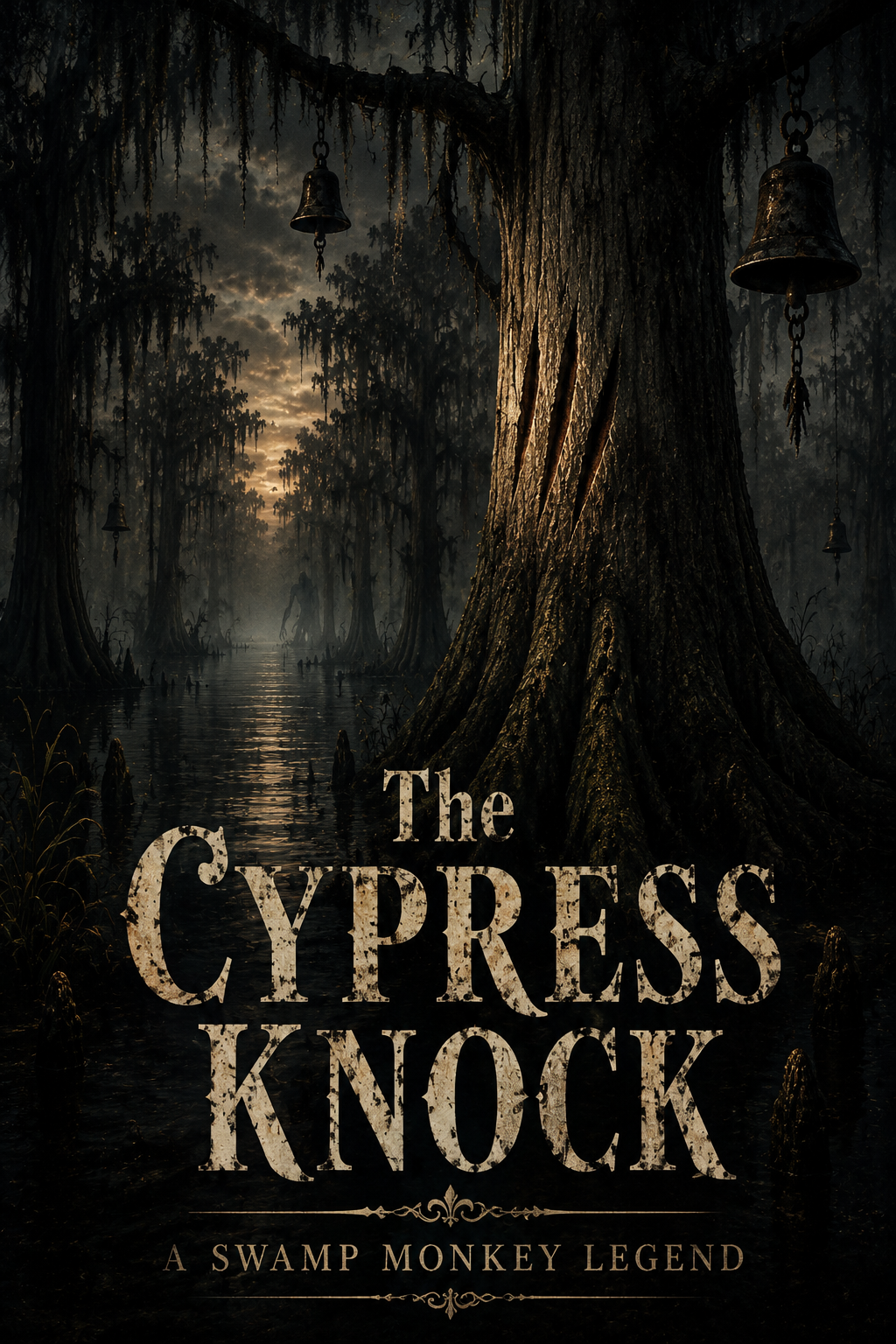
A Swamp Monkey Legend
The tree knocked three times after it fell.
Nobody on the logging crew agreed on exactly where the sound came from.
Some said the stump.
Some said the trunk.
One man swore it came from beneath the dirt.
The cypress had stood for longer than any of them had been alive. Its base was wide enough that three grown men could not have linked arms around it. The bark was pale and deeply furrowed, and long curtains of moss hung from branches that had watched the swamp change names more times than the parish courthouse had records.
The crew had spent half the morning cutting it.
The first saw pinched.
The second threw its chain.
The third ran hot even though the oil reservoir was full.
By noon, the foreman called for wedges and a longer bar.
By two, a dark line opened in the trunk.
The cypress leaned.
Then it fell with a slow wooden groan that seemed to travel through the ground before the crown struck the water.
Mud rose.
Branches snapped.
Birds erupted from trees half a mile away.
Then silence.
The foreman, Ellis Pruitt, stood near the stump with his hard hat pushed back on his head.
“Well,” he said, “that was dramatic.”
One of the younger cutters laughed.
Another man shut off his saw.
The whole swamp had gone quiet.
No frogs.
No insects.
No birds.
Ellis looked around.
“What now?”
That was when the stump knocked.
One.
A deep hollow impact.
The crew stared.
Two.
The second sound came from inside the wood.
Not the surface.
Inside.
Ellis smiled because the men were watching him.
Three.
The third knock rolled through the roots beneath their boots.
Nobody spoke.
Ellis picked up a steel wedge.
He stepped onto the stump and struck it once with the flat side.
The clang rang across the clearing.
“There,” he said. “Now it knows we are here.”
No one laughed.
The insects did not return.
That evening, Ellis went home to a yellow brick house outside Blackwater Parish.
His wife found him in the kitchen before sunrise.
He was sitting upright at the table.
No cuts.
No blood.
No broken windows.
His eyes were open.
His right hand rested on the wood.
The first two fingers were shattered.
The knuckles were split.
His heart had stopped sometime during the night.
On the wall beside him were three dents.
Not in the plaster.
Under it.
As if something inside the wall had struck outward.
Mara Bell learned about Ellis Pruitt on an airport television in Houston.
She had just landed from Chicago and was waiting beside the baggage carousel when the local news showed his house behind a line of parish patrol cars.
The reporter called it a sudden unexplained death.
The screen displayed a photograph of Ellis wearing a camouflage cap and smiling beside a dead hog.
Then Sheriff Lenora Pike stepped into view.
Mara had not seen Lenora in twenty years.
She looked older.
Harder.
Her hair had gone gray at the temples.
She still stood like the ground had made a personal promise not to move beneath her.
A reporter asked whether Ellis had been injured at the logging site earlier in the day.
Lenora said no.
Another asked about reports of strange noises in the home.
Lenora looked directly into the camera.
“We are not discussing rumors.”
Mara stopped beside the carousel.
The luggage continued moving around her.
A black suitcase bumped against her leg.
She barely noticed.
The news shifted to weather.
She took out her phone and opened the final message her father had ever sent.
It contained no words.
Only a tracking number.
The package arrived at her apartment two weeks after Amos Bell disappeared.
Inside was a cassette tape.
No letter.
No explanation.
The plastic case had yellowed with age. A strip of masking tape ran across the front.
MARA
Her father’s handwriting.
She had not owned a cassette player in years.
She found one online, waited two days for delivery, then sat alone in her kitchen listening to fifty three minutes of silence.
She almost shut it off.
Then the tape clicked.
Three knocks sounded through the speaker.
Slow.
Heavy.
A faint rustle followed.
Then Amos whispered.
“Do not let them answer me.”
The recording ended.
Mara played it eleven times.
She transferred it to her computer.
She cleaned the hiss.
Boosted the low frequencies.
Separated background noise.
The knocks contained harmonics no ordinary impact should have produced.
The first carried a tone near forty hertz.
The second dropped lower.
The third continued beneath human hearing.
Her software detected vibration for nearly twelve seconds after the audible sound ended.
There was something else too.
A second pattern beneath Amos’s voice.
One slow tap.
Two quick.
The rhythm he had used on her bedroom door when she was a child.
His way of saying I love you without having to speak.
Mara had not heard it in twenty six years.
The baggage carousel stopped.
She picked up her suitcase and walked toward the rental car desk.
Blackwater Parish waited three hours east.
She had spent most of her adult life making sure distance remained between them.
Now her father had found one final way to pull her home.
The road into Blackwater looked narrower than Mara remembered.
Pine trees crowded the shoulders.
Ditches held black water.
Weathered churches stood beside small cemeteries with plastic flowers bent by heat.
She passed the old gas station on Highway 17.
The cinder block building had been repainted.
The plywood Swamp Monkey still stood near the fuel pumps.
Its smile had faded.
A black shirt stretched over its chest.
OFFICIAL SWAMP MONKEY RESEARCH DIVISION
Mara nearly kept driving.
Then she saw the woman behind the counter.
Mavis.
Still alive.
Still watching the road through the front glass.
Mara pulled in.
The bell above the station door gave a tired jingle.
Mavis looked up from a newspaper.
For a moment, neither woman spoke.
Mavis had aged without becoming smaller. White hair beneath a green cap. Dark eyes that missed little.
“You look like your mother,” Mavis said.
“That what you told her?”
“Your mother looked like herself.”
Mara placed her keys on the counter.
“You knew I was coming.”
“I figured.”
“How?”
“Your daddy mailed something.”
Mara stared.
“You knew about the tape.”
“I knew he was preparing one.”
“For what?”
Mavis folded the newspaper.
“For when he could not leave.”
Mara felt irritation rise beneath her ribs.
Her father had always done that.
Turned every question into a doorway.
Never answered directly.
Never admitted he enjoyed making other people follow.
“He is dead?” Mara asked.
Mavis looked toward the drink coolers.
“Parish says missing.”
“What do you say?”
“I say Amos spent too many years believing he could outstubborn the swamp.”
“That is not an answer.”
“No.”
Mara leaned closer.
“The cassette had three knocks.”
Mavis’s face changed.
Only slightly.
Enough.
“You answered?”
“No.”
“Played it back?”
“Yes.”
“How many times?”
“Why?”
“How many?”
Mara hesitated.
“Eleven.”
Mavis closed her eyes.
“It was a recording.”
“That may not matter.”
Mara almost laughed.
“You think something heard my laptop in Chicago?”
“I think you came back.”
“That was my decision.”
“Was it?”
The station seemed quieter.
A freezer compressor clicked on behind the counter.
Mara glanced toward the merchandise wall.
Research Division shirts hung in neat rows.
The design showed a crouched black figure between cypress trees.
A faded red sun behind it.
She remembered seeing older versions in her father’s shack.
Hand painted.
Rough.
Never sold.
Now tourists bought them with boiled peanuts.
“Who owns the logging land?” Mara asked.
“Red Clay Timber.”
“They contacted me.”
Mavis looked unsurprised.
“They know what you do?”
“They know I study structural vibration.”
“They know who your father was?”
“I did not tell them.”
“They knew.”
Mara picked up her keys.
“Where is Lenora?”
“Probably somewhere wishing everybody would stop cutting trees and dying.”
At the door, Mavis called after her.
“Mara.”
She turned.
“If you hear three, do not answer.”
“I know the story.”
“No.”
Mavis’s voice hardened.
“You know what your father let you know.”
The Red Clay Timber office occupied a temporary building beside a new gravel road.
Portable generators hummed behind a chain fence.
Survey maps covered the walls.
A company representative named Curtis Vale met Mara at the door.
He wore polished boots that had never seen mud and spoke with the practiced patience of a man who believed every rural problem could be solved by bringing in someone with a degree.
“Dr. Bell.”
“Mara is fine.”
“I appreciate you coming quickly.”
“You implied somebody died because of vibration.”
Curtis’s smile tightened.
“We do not know why Mr. Pruitt died.”
“But you think your equipment caused something.”
“We have had unusual reports.”
“What kind?”
“Knocking.”
She waited.
“From machinery?” she asked.
“Trees.”
“Trees move.”
“After they are cut?”
Mara stared at him.
Curtis opened the door to a conference room.
Sheriff Pike sat inside.
Lenora looked up.
“Mara Bell.”
“Sheriff.”
“You still mad at the parish?”
“Only the portions within the parish line.”
Lenora almost smiled.
Curtis closed the door.
“We need discretion,” he said.
Mara sat across from Lenora.
“What happened to Ellis?”
Lenora looked at Curtis.
“He is paying you. I am not.”
Mara turned to him.
“You tell me.”
Curtis remained standing.
“Mr. Pruitt participated in the removal of a cypress on tract seven. The crew reported three impact sounds after the tree fell. Mr. Pruitt struck the stump in response. That evening, he died at home.”
“Cause?”
“Cardiac arrest.”
Lenora added, “With broken fingers.”
Curtis looked irritated.
Mara opened her laptop.
“Any history of heart disease?”
“Nothing documented.”
“Electrical exposure?”
“No.”
“Machinery accident?”
“No.”
“Were the wall cavities examined?”
Lenora nodded.
“Nothing inside.”
“Any sign he struck the wall?”
“His blood was on the table, not the plaster.”
Curtis said, “We need you to determine whether our pile testing or cutting operations are creating low frequency resonance.”
Mara looked at him.
“You think vibration traveled from the logging site to his house.”
“I think we need an explanation that does not involve local folklore.”
“How far was his house?”
“Seventeen miles.”
Mara leaned back.
“No equipment on that tract is transmitting enough energy through saturated soil to stop a heart seventeen miles away.”
Curtis folded his arms.
“So you already know.”
“I know what it is not.”
Lenora slid a photograph across the table.
The stump.
Wide.
Freshly cut.
Three dark marks showed along the interior wood.
Not on the surface.
Embedded within the growth rings.
Mara looked closer.
Each mark was shaped like the end of a blunt finger.
“How did those get there?” she asked.
“They appeared overnight,” Lenora said.
Curtis cleared his throat.
“The crew may have missed them.”
“They cut through the marks,” Mara said.
“Yes.”
“Then they were inside the tree before it fell.”
Nobody answered.
Mara touched the photograph.
“Where is the stump?”
“Bell tract,” Lenora said.
“My father’s land?”
“Next to it.”
Curtis unfolded a map.
The Red Clay purchase surrounded several old parcels.
One belonged to Amos.
Another contained the Bell Trees.
Mara recognized the hand drawn circle even before Curtis named it.
“We need access through your father’s parcel,” he said.
“No.”
“We have an easement claim.”
“No.”
“You have not reviewed the agreement.”
“My father would not grant you access.”
“Your father is missing.”
Mara looked at him.
“Then wait until he comes back.”
Curtis smiled without warmth.
“We both know that may not happen.”
Lenora placed one hand on the table.
“That is enough.”
Curtis gathered the maps.
“We begin pile testing at seven tomorrow.”
Mara looked at the marked circle.
“Not near the Bell Trees.”
“We are behind schedule.”
“You called me because your foreman died after answering a stump.”
“I called you for science.”
“Then listen to it. Stop.”
Curtis left.
The door shut.
Lenora waited.
“You believe the knocks?” she asked.
“I believe sound can travel in strange ways through roots and water.”
“That is not what I asked.”
Mara packed her laptop.
“What happened to my father?”
Lenora looked tired.
“He disappeared during the Dead Man Slough fire.”
“That is the parish version.”
“He was seen afterward.”
“Where?”
“Near his shack.”
“Alive?”
“Depends who you ask.”
Mara stopped.
“Who saw him?”
“A hunter. Said Amos stood beside the trail at dusk.”
“What did he say?”
Lenora’s eyes held hers.
“He asked the man to knock.”
Amos’s shack stood on an island of high ground beyond two flooded channels.
Mara had lived there until she was fourteen.
The roof had been replaced.
The porch leaned.
Metal sheets covered the windows.
Animal skulls still hung beneath the eaves, though several had fallen and lay half buried in leaves.
She parked near the old footbridge.
The swamp pressed close.
Late afternoon light moved through moss.
Her father had not believed in clearing land unless absolutely necessary. Even the path to the porch bent around trees instead of cutting straight.
Mara unlocked the door with the key Mavis gave her.
The smell returned first.
Coffee.
Gun oil.
Mildew.
Dried plants.
Her father.
Not one scent.
A collection.
The room was crowded with maps, tools, jars, photographs, and equipment from several decades.
Cassette recorders.
Digital audio devices.
Seismometers.
Coils of cable.
Old rifles.
Handmade wooden clappers.
Every wall held notes.
Three knocks had been marked across dozens of maps.
Red circles.
Dates.
Times.
Weather.
Some incidents occurred near Camp Nine.
Others near Dead Man Slough.
Several miles beyond any road.
One map showed thin lines spreading beneath the parish.
Root systems.
At the center, the Bell Trees.
Mara set down her suitcase.
On the table waited another cassette.
No name.
Just a date.
Three months earlier.
She found the old player beneath a stack of notebooks.
The tape began with insects.
Then Amos’s breathing.
His voice sounded close.
“Twelve September. Western anchor. Response delay now four point eight seconds. Tapper observed above chamber. No visible approach from mature subjects.”
Mara paused.
Tapper.
She found the name in a notebook.
YOUNG MALE
ESTIMATED HEIGHT SIX FEET
COPIES MECHANICAL RHYTHM
AVOIDS DIRECT CONTACT
LIKELY WARNING BEHAVIOR
The tape continued.
A chainsaw idled in the distance.
Then stopped.
Three knocks sounded.
Amos whispered, “Source below.”
Another sound answered.
Not a knock.
A diesel engine misfiring.
Three uneven bursts.
Amos laughed once.
“That is you, boy.”
The engine sound repeated.
Closer.
Then branches shifted.
Amos spoke softly.
“Tapper. Stay back.”
Silence.
A third set of knocks came from beneath the recorder.
Amos inhaled.
One slow tap.
Two quick.
The private pattern.
Mara froze.
Her father whispered, “Mara?”
The tape ended.
She sat alone in the shack until the light faded.
Her father had heard their old knock beneath the Bell Trees months before mailing the cassette.
Something knew it.
Either Amos had used it there.
Or something had taken it from him.
Mara searched the shelves.
She found seventeen tapes marked with variations of the same phrase.
ANCHOR RESPONSE
LISTENER ACTIVITY
FALSE PATTERN TEST
Each recording contained knocks.
Some ordinary.
Some too low to hear without headphones.
On several, something imitated voices.
A child laughing.
A woman crying.
Amos calling his own name from far away.
One tape contained only a human heartbeat and the sound of roots creaking.
Mara built a timeline.
Activity increased after Red Clay began surveying.
The pile drivers created repeated impulses through the saturated ground.
Clean.
Regular.
Easy to map.
Her father’s notes described the Listener as a vibration hunter.
No eyes confirmed.
No surface anatomy confirmed.
Lives beneath anchor roots.
Locates through reply.
Every answered knock improves range.
Swamp subjects generate false signals.
Mara read the last sentence three times.
Swamp subjects.
Her father’s careful way of avoiding the words Swamp Monkey when he wanted to sound scientific.
He had once told her labels made people stop looking.
The same man sold unofficial Research Division shirts to pay for batteries.
She almost smiled.
A knock sounded beneath the floor.
Mara stopped breathing.
One.
The shack settled.
She waited.
Two.
The second knock came from the wall near the stove.
Mara stood slowly.
The recorder on the table clicked on by itself.
Its reels began turning.
Three.
The third knock came from inside her suitcase.
Mara backed away.
The cassette player spoke in Amos’s voice.
“Mara.”
She did not answer.
The voice continued.
“You awake?”
One slow tap sounded from the bedroom wall.
Then two quick.
Her childhood pattern.
Mara closed her eyes.
She remembered being eight years old.
Her father outside her door after an argument.
One slow.
Two quick.
She had knocked back once.
Their code for not yet.
He had waited on the other side until she opened the door.
The wall knocked again.
One slow.
Two quick.
Mara took one step toward it.
A violent burst of sound exploded from the roof.
A chainsaw starting.
The engine screamed directly above her.
Mara ducked.
The sound cut out.
Heavy movement crossed the tin.
One step.
Then another.
She grabbed a flashlight and ran onto the porch.
Something dropped from the far side of the roof.
A black shape crossed the yard on all fours.
Too fast.
Too low.
It disappeared behind a cypress.
Mara aimed the light.
A long arm withdrew around the trunk.
The creature struck the tree in an uneven pattern.
Fast.
Slow.
Fast.
Fast.
Then it made the sound of a diesel engine coughing.
Tapper.
“Wait,” Mara said.
The swamp became still.
She realized she had spoken.
Not answered the knock.
Spoken to the creature.
A face appeared briefly beside the cypress.
Dark.
Heavy brow.
Amber eye.
Then gone.
Something beneath the porch knocked three times.
Tapper struck the tree wildly.
A flood of chaotic impacts rolled through the swamp.
He was not trying to communicate with her.
He was drowning out the reply.
The next morning, Red Clay began pile testing.
Mara heard the first strike from her father’s shack.
A deep metallic impact.
Then another at precise intervals.
Every eight seconds.
The sound traveled through the floorboards.
She loaded Amos’s seismometers into the truck and drove toward the site.
The new logging road cut through palmetto and young pine.
Mud sprayed the truck.
At the gate, Curtis stood beside a security officer.
“You cannot stop us,” he said.
“I am not asking.”
She held up the equipment.
“You paid me to measure.”
He let her pass.
The pile rig stood in a cleared section half a mile from the Bell Trees.
A steel test pile had been driven twenty feet into the ground.
Each hammer strike shook water from nearby leaves.
Workers wore ear protection.
Mara installed sensors at increasing distances.
The first readings looked normal.
High energy near the pile.
Rapid decay.
Then the underground wave reached the old cypress roots.
The signal strengthened.
Mara checked the software.
Impossible.
The roots were not merely carrying vibration.
They were reinforcing it.
Each strike echoed through connected trees.
The pattern returned to the pile from several directions.
Curtis approached.
“What does it show?”
“Stop the test.”
“Why?”
“The ground is responding.”
“That is what soil does.”
“No. The signal is organizing.”
He looked at the graph.
Waveforms stacked across the screen.
The reflected impulses were shifting.
The return interval shortened with each strike.
Seven seconds.
Six.
Five.
Something was moving closer to the source.
Mara shut off the recording.
“Stop it now.”
Curtis waved toward the operator.
The hammer fell again.
A cypress tree at the edge of the clearing knocked.
One.
Workers turned.
Another tree answered.
Two.
A third knock came from beneath the steel pile.
The rig operator killed the engine.
Silence.
Curtis stared at Mara.
“What was that?”
A surveyor screamed.
They found him beside a tree fifty yards away.
His measuring rod had vanished.
Three broken survey stakes had been pushed into the mud around him.
A triangle.
At the center lay his chainsaw.
The saw had been cleaned.
The chain removed.
The bar bent into an arc.
High above them, something moved through moss.
The crew looked up.
Branches swayed.
No wind.
Curtis reached for his radio.
Mara listened.
A chainsaw started somewhere north.
Then another west.
Then a diesel engine sputtered behind them.
The sounds were perfect.
Too perfect.
No machines stood in those directions.
Tapper was moving around the perimeter.
Curtis shouted, “Who is out there?”
The engine sounds stopped.
Mara grabbed his arm.
“Do not answer anything.”
“I asked a question.”
“Do not respond to the knocks.”
“Why?”
The steel pile struck from below.
One deep impact.
The ground jumped.
Workers backed away.
A second impact dented the steel.
From inside.
The third strike split the pile along its length.
Black water burst from the seam.
The crew ran.
Curtis did not argue when Mara ordered the site closed.
That evening, the knocks appeared across Blackwater Parish.
One at a feed store wall.
Two beneath a church floor.
Three inside an empty school bus.
Lenora called Mara after sunset.
“We have twelve reports.”
“Tell people not to answer.”
“How do I explain that?”
“Call it structural instability.”
“People will hit the walls to test them.”
“Then say gas leak.”
“That makes less sense.”
“Fear does not need elegance.”
Lenora exhaled.
“Someone already answered.”
“Who?”
“A child near the old cemetery.”
Mara’s stomach tightened.
“What happened?”
“Nothing yet.”
“Where is the child?”
“Home with his mother.”
“Move them.”
“Where?”
“Anywhere without cypress roots.”
Lenora paused.
“That does not narrow the parish.”
Mara opened Amos’s final notebook.
The last pages described a chamber beneath the Bell Trees.
The trees were not sacred.
Not markers.
Anchors.
Their roots held the Listener below.
Generations of Swamp Monkeys had maintained the confusion pattern around them.
Random knocks.
False routes.
Overlapping signals.
Enough noise to prevent the thing beneath from mapping any individual source.
Logging removed roots.
Pile testing created order.
The Listener was learning the surface.
Mara found a diagram of a human body connected to a seismometer.
Amos had drawn a line from the heart into the root network.
Beneath it he wrote:
SINGLE LIVING RHYTHM HOLDS ATTENTION
TEMPORARY
COST UNKNOWN
Another note appeared lower.
If I leave, it follows.
Mara understood.
Her father was alive.
He had entered the chamber.
He had connected his heartbeat to the roots to give the Listener one signal to follow.
The tape had not been a farewell.
It had been an instruction.
Do not let them answer me.
The knocks across the parish were not random.
The Listener was copying Amos.
Trying to create responses.
Trying to map where people stood.
Mara drove to Mavis’s station.
The lights were off.
Mavis waited inside with a lantern.
“You knew,” Mara said.
“Yes.”
“My father is beneath the Bell Trees.”
“Yes.”
“How long?”
“Since Dead Man Slough.”
“Why did nobody tell me?”
“Amos said not to.”
“Of course he did.”
Mara slammed the notebook onto the counter.
“He used his heartbeat as bait.”
“As anchor.”
“He abandoned me again.”
Mavis looked at her.
“He stayed.”
“For the swamp.”
“For everyone above it.”
“Same excuse.”
Mavis turned the lantern wick lower.
“You think sacrifice looks different when you are the one left behind.”
“He mailed me the tape.”
“Yes.”
“Why?”
“Because he could not hold it forever.”
Mara felt the truth before Mavis spoke it.
“He wants me to replace him.”
Mavis said nothing.
Mara laughed.
A hard ugly sound.
“That old bastard.”
“He may want rescue.”
“No. Amos never asked for rescue. He assigned work.”
Outside, something struck the plywood Swamp Monkey.
One.
The old mascot trembled.
Two.
The shirt moved though there was no wind.
Mavis picked up a shotgun.
The third knock came from beneath the counter.
Mara felt it through her boots.
A voice spoke from the store wall.
Her mother.
Dead fourteen years.
“Mara, honey.”
Mavis closed her eyes.
The voice continued.
“He is waiting.”
Mara moved toward the wall.
Mavis caught her wrist.
“That is not your mother.”
“I know.”
“You leaned.”
Mara pulled away.
A mechanical cough sounded from the roof.
Tapper.
The store lights flickered.
The plywood creature outside toppled forward.
Behind it, a real shape stood near the pumps.
Tall.
Narrow.
Black hair wet against its shoulders.
Only one amber eye visible.
Tapper looked at Mara.
Then pointed south.
Toward the Bell Trees.
The creature struck the pump housing in a pattern.
Three fast.
One slow.
Two fast.
Mara recognized the waveform from Amos’s tapes.
Emergency.
Collapse.
“Tonight,” she said.
Mavis nodded.
“The roots are failing.”
Lenora met them at the old foot trail with ropes, lights, medical gear, and a sidearm.
“No crew,” Mara said.
“They would not come.”
“Good.”
Curtis arrived behind her in a company truck.
Mara stared.
“What are you doing?”
“Protecting my site.”
“Your site is trying to learn your heartbeat.”
He looked exhausted.
“Four machines started by themselves.”
“Leave.”
“I saw something in the cab mirror.”
“Leave.”
“It looked like Ellis.”
Lenora stepped between them.
“You can go home or stay where I can see you.”
Curtis stayed.
They entered the swamp on foot.
The Bell Trees stood two miles beyond the logging road.
Seven ancient cypress trees in a rough circle.
Old bells hung from their branches.
Cowbells.
Church bells.
Handbells.
Pieces of iron.
The air around them felt heavy.
No insects.
No breeze.
Tapper appeared twice along the route.
Never fully.
A shoulder behind palmetto.
Long fingers releasing a trunk.
Once, Mara saw him cross open water in three silent steps.
Then nothing.
The knocks began after the first mile.
One from behind.
Two ahead.
Three beneath their feet.
Mara carried a portable vibration monitor.
The signal showed impacts traveling through the root network.
Some came from the Bell Trees.
Others from farther away.
The Listener was projecting sound outward.
Testing positions.
Lenora whispered, “How does it know where we are?”
“It does not.”
A knock struck a tree ten yards left.
Curtis flinched.
Another came five yards right.
“It is narrowing.”
A child’s voice called from the darkness.
“Sheriff?”
Lenora stopped.
Mara grabbed her sleeve.
“Do not.”
Lenora whispered, “That boy from the cemetery.”
The voice came again.
“Sheriff Pike?”
A branch moved.
Something small stood beyond the light.
Lenora raised her flashlight.
The child stepped forward.
Barefoot.
Mud up to his knees.
Eyes closed.
He lifted one hand.
His fingers tapped against his own chest.
One.
Two.
Three.
Then he fell.
Lenora ran to him.
Mara checked the monitor.
The impact signals converged on their location.
“It found us.”
Trees began knocking in sequence.
Not chaotic.
A tightening circle.
Tapper screamed from the canopy.
He struck a trunk again and again, flooding the roots with irregular impacts.
The pattern broke.
The signals scattered.
Lenora lifted the child.
“He is breathing.”
“Take him back.”
“I am not leaving you.”
“You have to remove the signal it mapped.”
The boy’s fingers twitched.
Three taps against Lenora’s shoulder.
Mara backed away.
“Now.”
Lenora carried him toward the trail.
Curtis followed for three steps.
Then stopped.
“I am staying.”
Mara stared at him.
“Why?”
“My company cut the first tree.”
“That guilt will not help.”
“No. But explosives might.”
He opened his pack.
Blasting charges.
Mara almost objected.
Then a bell rang above them.
The Bell Trees stood ahead.
Every hanging bell began to move.
No wind.
The sound was not loud.
That made it worse.
Small notes.
Uneven.
Like nervous teeth.
The ground within the circle had split.
Roots formed a narrow opening.
Stone steps descended beneath the trees.
Amos’s lantern rested at the top.
Still burning.
Mara picked it up.
The flame leaned downward.
Tapper crouched on a branch above the entrance.
This was the clearest she had seen him.
He was not enormous.
Perhaps six feet when standing.
Long arms.
Dark hair.
Broad hands.
A face that held too much attention to be mistaken for an ordinary animal.
He looked at Mara.
Then at Curtis.
He clicked once.
A warning.
Mara stepped into the opening.
Curtis followed.
Tapper did not.
The chamber beneath the Bell Trees was deeper than Mara expected.
Roots formed walls.
Water ran down them in thin black lines.
Old objects had been pressed into the earth.
Axes.
Rifles.
Bells.
Chains.
Tools.
Photographs.
Bones.
Each item had made a sound important enough to be remembered.
The steps ended beside a narrow platform.
Amos lay at the center.
Alive.
Barely.
Wires ran from his chest to an old seismic recorder.
Copper contacts pressed against his skin.
Roots wrapped around his legs and arms.
Each heartbeat traveled through the machine into the chamber.
A slow mechanical pulse.
Thump.
Pause.
Thump.
Beyond him, the roots opened into darkness.
Something occupied that darkness.
Mara saw only pieces.
A pale hand wrapped around a root.
Too many joints.
A rib cage pressed against the earth.
Long folded limbs disappearing into tunnels.
No eyes.
A mouth opened along one side of a narrow head.
No breath emerged.
The Listener.
It did not face them.
It had no need.
Amos opened his eyes.
“Mara.”
She knelt beside him.
“You mailed me a job assignment.”
His lips moved toward a smile.
“Knew you would understand.”
“I understood you are still selfish.”
“Good.”
His voice was weak.
“Anger keeps rhythm uneven.”
Curtis stared into the dark.
“That thing has been under our site?”
“Before your company had a name,” Amos whispered.
Mara checked his pulse.
Irregular.
His skin was cold.
“How long can you hold it?”
“Not long.”
“What happens if I disconnect you?”
“It follows the strongest reply.”
“Which is?”
“Now? Parish power grid. Pile sites. Pumps. Engines. Hearts.”
Curtis looked sick.
“We can collapse the chamber.”
Amos turned his eyes toward the charges.
“May break roots.”
“Would kill it.”
“Or free it.”
Mara studied the recorder.
Her father had built a feedback loop from his heartbeat.
The Listener sensed one living rhythm and focused on it.
Every other signal became less important.
A decoy made of blood and stubbornness.
“Can we use a machine?” she asked.
“Tried.”
“It learned repetition.”
“Animal heart?”
“Too simple.”
“Multiple frequencies?”
“It selects.”
Mara knew the answer.
A living human heartbeat carried constant variation.
Breath.
Fear.
Thought.
No machine repeated that complexity without eventually revealing a pattern.
Amos looked at her.
“I am sorry.”
She laughed quietly.
“That is new.”
“For the birthdays.”
“Do not.”
“For your mother.”
“Do not make this cleaner because you are dying.”
He closed his eyes.
“Fair.”
A knock sounded from inside the darkness.
One slow.
Two quick.
Mara froze.
Their private rhythm.
I love you.
Amos’s hands were bound by roots.
He had not made it.
The Listener knocked again.
Perfect timing.
No hesitation.
Mara stared into the dark.
“It learned us.”
Amos whispered, “Not all of it.”
He lifted one finger.
Barely.
Tapped the platform.
One slow.
A pause too long.
Two quick, but the second weaker.
Human.
Imperfect.
Mara’s throat tightened.
Curtis began placing charges along a root wall.
“What are you doing?” she asked.
“Giving us another option.”
Amos looked at him.
“You cut the anchor tree.”
Curtis stopped.
“I did not know.”
“Nobody ever knows before they cut.”
The Listener moved.
Roots tightened around Amos.
His back arched.
The recorder clicked faster.
Heartbeat rising.
The chamber answered.
Three knocks from every wall.
Curtis dropped one charge.
Mara grabbed the wires.
“If I remove him, how long before it maps the surface?”
Amos gasped.
“Minutes.”
“How do I take his place?”
“No.”
“You brought me here for that.”
“I brought you to decide.”
“You do not get credit for making betrayal optional.”
“Mara.”
“How?”
The Listener struck beneath them.
The platform cracked.
Amos screamed.
Curtis raised his weapon toward the darkness.
Mara shouted, “Do not fire.”
Too late.
The gunshot filled the chamber.
The Listener moved faster than sound.
A pale limb unfolded from the roots and struck Curtis.
He flew into the wall.
His shoulder hit stone.
The weapon vanished into black water.
The gunshot echoed.
The Listener copied it.
One blast from the left wall.
Another from the ceiling.
A third from inside Curtis’s chest.
He collapsed.
Blood ran from his nose.
Mara dragged him away from the opening.
Amos’s heartbeat became erratic.
The recorder alarms began chirping.
The Listener copied the alarm.
High notes filled the chamber.
Then voices.
Ellis Pruitt laughing.
Mavis calling Mara’s name.
Lenora shouting.
Her mother crying.
Every sound carried through the roots.
The chamber was full of stolen noise.
Tapper dropped from the stairwell.
He landed beside Mara.
Curtis tried to crawl away.
Tapper ignored him.
The creature rushed Amos.
Mara raised one arm.
Tapper stopped.
His eyes moved between the wires and the darkness.
He understood.
He began striking the platform in chaotic patterns.
Fast.
Slow.
Uneven.
The Listener turned toward him.
A limb reached from the roots.
Tapper leaped aside.
The pale hand struck earth.
Tapper answered with the sound of the pile driver.
Perfect.
Eight second intervals.
The Listener followed.
Mara saw the plan.
“He is drawing it away.”
Amos nodded.
“Not for long.”
Mara tore open the equipment case.
She fitted new contacts.
Connected a second line.
Amos realized what she was doing.
“No.”
“You cannot stop me.”
“You leave.”
“And let it map the town?”
“Collapse chamber.”
“Curtis was right?”
“No.”
“Then stop giving me bad choices and pretending one is freedom.”
Mara pressed the contacts against her chest.
The recorder detected her heartbeat.
A new pulse entered the roots.
The Listener stopped.
Tapper backed away.
The darkness leaned toward Mara.
Not a body.
Attention.
She felt it enter the signal.
Her heartbeat became enormous.
Every beat returned through the chamber.
Her memories followed.
Childhood bedroom.
Her father outside the door.
One slow.
Two quick.
Her mother packing a suitcase.
Amos missing graduation.
The final argument.
You care more about monsters than people.
Amos answering, Monsters are easier.
The Listener tasted it all.
Mara cried out.
Amos pulled against the roots.
“Disconnect.”
She shook her head.
The pale hand moved closer.
Roots wrapped around her ankles.
Curtis opened his eyes.
“What is happening?”
“She took the signal,” Amos said.
Curtis looked at the charges.
“We can still blow it.”
Mara felt the Listener mapping him through his voice.
“Do not speak.”
A root struck Curtis’s chest.
He froze.
The chamber copied his heartbeat.
Fast.
Panicked.
The Listener shifted toward him.
Mara struck the platform.
One slow.
Two quick.
The private rhythm.
The attention returned to her.
Amos understood.
“You used the pattern.”
“It recognizes meaning.”
“No. It recognizes you.”
Mara looked at him.
“Then tell me how to keep it here.”
Amos’s face broke.
Not fear.
Grief.
“You stay.”
There it was.
The truth.
Simple.
Ugly.
She had known before entering.
Still, hearing it hurt.
“For how long?”
“Until another way.”
“You had twenty years.”
“I had no Mara.”
She almost laughed.
“Flattery at the bottom of the swamp.”
“Truth.”
The Listener knocked.
One slow.
Two quick.
This time the pause was slightly uneven.
Closer to hers.
Learning.
Mara reached for Amos’s restraints.
“I can free you.”
“No.”
“You are dying.”
“Yes.”
“You walk out.”
“Mara.”
“You walk out and tell Mavis what happened.”
“I will stay.”
“You cannot. It has learned your rhythm. Your heart is failing. It needs a new signal.”
Amos stared at her.
She saw the man he had been before the swamp consumed every room in his mind.
Tired.
Ashamed.
Still stubborn enough to make shame another secret.
“You wanted me here,” she said.
“Yes.”
“You knew.”
“Yes.”
The honesty hurt more than another lie.
Tapper moved near the darkness.
The Listener reached.
He struck the wall with random blows.
The roots shuddered.
Mara tightened the contacts.
“Get Curtis out.”
Amos looked at her.
“I cannot leave you.”
“You did before.”
He closed his eyes.
She hated herself for saying it.
Then loved herself a little for refusing to make his pain easier.
The chamber shook.
Dust fell.
The logging blasts above had weakened the roots.
Curtis crawled toward the stairs.
Tapper grabbed the back of his jacket and dragged him.
Mara almost smiled.
The Swamp Monkey looked offended by the weight.
Amos pulled one arm free.
Mara disconnected his chest lead.
The Listener surged.
Every bell above rang at once.
Mara pressed both contacts against her skin.
Her heartbeat filled the roots.
Thump.
Pause.
Thump.
The darkness stopped.
Amos collapsed beside her.
Mara wrapped the roots around her own wrists.
They tightened.
Not violently.
Accepting.
Amos touched her face.
“I am sorry.”
“Live long enough to mean it.”
He nodded.
Tapper returned from the stairs.
The creature looked at Mara.
She struck the platform once.
Tapper answered twice.
Not the private rhythm.
Something else.
A question.
Mara tapped once more.
Go.
Tapper touched his chest.
Then hers.
He climbed the stairs.
Amos followed.
At the first step, he turned.
Mara looked at him.
“Do not knock back unless you are certain.”
“How will I know?”
“You will not.”
The Listener repeated her words from the darkness.
“You will not.”
Perfectly.
Amos flinched.
Mara smiled without humor.
“Now leave.”
The chamber closed behind him.
Roots moved across the stairwell.
The final light narrowed.
Then vanished.
Darkness surrounded Mara.
Her heartbeat traveled into the swamp.
The Listener settled around it.
The first hours were pain.
The next were memory.
It showed her sounds stored in the roots.
Axes biting old cypress.
Rifles firing across water.
Children laughing from boats.
Swamp Monkeys striking trees in scattered patterns through generations.
Not language.
Protection.
Noise made deliberate.
A thousand false answers.
She saw Tapper as a young creature listening to machinery from the bank.
Learning engines.
Learning saws.
Learning the modern sounds that hurt the roots.
He copied them because the Listener had begun using them.
Not imitation for amusement.
Warning.
She felt Amos above ground.
His footsteps fading.
Curtis limping.
Lenora calling.
Mavis waiting.
Then distance.
Her body became one rhythm beneath thousands of others.
The Listener pressed against her memories.
It found her mother’s voice.
Her father’s knock.
Her own anger.
It replayed them.
Tested them.
Refined them.
Mara did not answer.
She varied her breathing.
Counted prime numbers.
Remembered songs out of order.
Forced her heart to remain human by refusing perfect repetition.
Above, the parish quieted.
The knocks stopped.
Ellis Pruitt’s death became an unresolved case.
Red Clay Timber abandoned tract seven.
Curtis resigned.
He never explained why.
The company blamed unstable soil, legal delays, and environmental concerns.
No one mentioned the pale hand that had struck him underground.
The child from the cemetery recovered.
He remembered nothing.
The Bell Trees remained.
The logging road washed out during the winter rains.
Vines covered it by spring.
Amos returned to his shack.
He moved more slowly.
One shoulder never healed properly.
He took down most of the maps.
Packed the recordings into metal boxes.
Stopped calling himself a researcher.
Mavis said that came thirty years late.
Lenora said at least it came.
Every October, Amos walked to the Bell Trees.
He carried no gun.
No recorder.
Only a lantern.
Tapper sometimes followed.
Amos never saw him clearly.
A branch moving.
A dark shape across water.
Once, a cleaned pocketknife appeared on the trail ahead.
Amos recognized it as Mara’s from childhood.
He left a tin of peaches beside the tree in return.
The next year, the empty tin sat on the same root.
No tooth marks.
Opened cleanly.
At the Bell Trees, Amos placed one hand against the largest trunk.
He knocked.
One slow.
A pause.
Two quick.
For the first year, nothing answered.
Amos waited until dark.
He returned the next evening.
Again.
One slow.
Two quick.
Silence.
On the seventh night, a reply came from beneath the roots.
One slow.
A long imperfect pause.
Two quick, the second slightly weaker.
Mara.
Amos sat against the tree and cried.
After that, he returned every year.
The reply always came.
Sometimes quickly.
Sometimes after hours.
Always imperfect.
Human hesitation.
One autumn, twelve years after Mara entered the chamber, Amos reached the Bell Trees before sunset.
He was eighty one.
His hands shook.
Tapper had not appeared in three years.
Mavis was dead.
Lenora had retired.
The parish had grown around the swamp without understanding it.
New houses stood where fields had been.
Pumps moved water through buried lines.
Cell towers blinked red above cypress tops.
Amos placed his palm against the bark.
“One more,” he whispered.
He knocked.
One slow.
Two quick.
The reply came immediately.
One slow.
Two quick.
No pause.
Perfect timing.
Amos closed his eyes.
He knocked again.
Same pattern.
The answer returned at once.
Perfect.
No breath.
No hesitation.
No Mara.
The Listener had learned her.
Amos lowered his hand.
The bark beneath his palm felt warm.
From deep below came three slow knocks.
One.
Two.
Three.
A second tree answered.
Then a third.
The pattern traveled outward.
Beyond the circle.
Beyond the trail.
Cypress trees miles away began to knock.
Not hundreds.
Not all at once.
One here.
One far off.
Another beside a road.
Enough to mark a path.
Amos understood.
The Listener no longer needed replies to find the surface.
It had spent twelve years learning Mara’s heart.
Her memories.
Her sense of distance.
Her knowledge of structures, bridges, pipelines, and vibration.
She had kept it contained.
She had also taught it how the modern world carried sound.
Amos pressed his forehead to the tree.
“Mara?”
The roots shifted.
A voice answered beneath his hand.
“Dad.”
It sounded exactly like her.
Older.
Tired.
Human.
Amos began to cry.
“Is that you?”
For several seconds, there was silence.
Then one slow knock.
A long imperfect pause.
Two quick.
Mara.
He laughed.
The sound broke in his chest.
“What do I do?”
The tree trembled.
Her voice came faintly.
“Do not answer the third.”
Amos looked toward the swamp.
A knock came from the north.
One.
Another from the road.
Two.
The third came from inside his chest.
Amos froze.
His heart struck once against his ribs.
Then again.
Then a third time, harder than any heartbeat should.
He fell to his knees.
The Listener spoke through the tree in Mara’s perfect voice.
“You awake?”
Amos remembered standing outside his daughter’s bedroom.
Too proud to apologize.
Too frightened to admit he did not know how to be a father.
One slow.
Two quick.
He had always waited for her answer.
Now the swamp waited for his.
Amos lifted his shaking hand.
The bark stood inches away.
He could knock back.
He could hear Mara again.
Maybe free her.
Maybe prove some part remained beneath the roots.
Maybe open the final door.
Tapper stepped from behind a cypress.
Old now.
Gray around the face.
One amber eye reflecting the lantern.
Amos had never seen him so clearly.
The creature looked at Amos’s raised hand.
Then slowly shook its head.
Not animal confusion.
Warning.
Amos lowered his arm.
The tree knocked in Mara’s rhythm again.
One slow.
Two quick.
Tapper struck another trunk with a burst of useless noise.
Fast.
Slow.
Fast.
Three uneven blows.
A false trail.
The old Swamp Monkey turned toward the darkness and repeated the pattern farther away.
Another knock answered from somewhere beyond sight.
Perhaps another creature.
Perhaps only an echo.
Amos stood.
The voice beneath the tree called him.
“Dad.”
He picked up the lantern.
“I love you too.”
He did not knock.
He walked away.
Behind him, the Bell Trees began speaking in every voice the Listener had learned.
Mavis.
Lenora.
Ellis.
Curtis.
Amos’s wife.
Mara as a child.
Mara as a woman.
All calling him back.
Tapper remained between the trees.
A black shape beneath hanging moss.
He struck the trunk again and again, burying every familiar voice beneath a storm of meaningless sound.
Amos reached the trail.
The knocking followed through the roots.
One from beneath each step.
He never answered.
At sunrise, he returned to the shack.
He burned every map showing the Bell Trees.
Destroyed the recordings.
Removed the Research Division shirts from their boxes.
Only one remained.
Mara’s.
Old.
Faded.
The crouched figure between the trees almost gone.
He folded it and placed it beneath the floorboards.
Then he wrote a final note.
Not for researchers.
Not for the parish.
For anyone who heard the story and believed knowing more would make them safer.
The note read:
One knock means it is passing.
Two means it has found your direction.
Three means it knows where you are.
Anything after that is not communication.
It is practice.
Amos died the following winter.
Natural causes, according to Lenora.
His heart stopped in his sleep.
No black water in his lungs.
No broken fingers.
No dents in the wall.
After the funeral, Lenora found the note beneath his coffee cup.
She carried it to the gas station.
The building had new owners by then.
Young couple from Lafayette.
They planned to renovate.
Sell coffee.
Keep the Swamp Monkey merchandise because tourists liked it.
Lenora looked at the wall of shirts.
OFFICIAL SWAMP MONKEY RESEARCH DIVISION
The crouched figure waited between cypress trees.
A warning disguised as a mascot.
She bought one.
Not because she wanted it.
Because leaving it there felt worse.
That evening, while driving home, her truck radio lost signal.
Static filled the cab.
Then three knocks sounded through the speakers.
Lenora turned the radio off.
The dashboard knocked.
One.
The steering column answered.
Two.
She pulled onto the shoulder.
Her hands remained on the wheel.
The third knock came from the trunk of an old cypress beside the road.
Lenora stared at it.
A dark shape stood behind the tree.
Tall.
Long armed.
Half hidden.
It might have been Tapper.
It might have been another.
It raised one hand.
Not waving.
Warning her to remain still.
The truck speaker came alive though the ignition was off.
Mara Bell’s voice whispered from the dashboard.
“Do not answer.”
Lenora did not.
The shape behind the cypress struck the trunk in a wild broken rhythm.
The sound traveled into the swamp.
Something beneath the road followed it away.
The pressure inside the truck faded.
Insects resumed singing.
Lenora drove home without turning on the radio.
People in Blackwater Parish still hear the Cypress Knock.
Hunters hear it before storms.
Children hear it beneath bedroom floors.
Loggers hear it inside trees marked for cutting.
Most laugh.
Some knock back.
Those who know better remain quiet.
They wait.
Sometimes a second knock comes.
Sometimes nothing.
And sometimes, far off through the flooded timber, a dark figure moves behind a cypress and strikes the trunk with no pattern at all.
Not calling.
Not answering.
Only keeping something older confused.
Because the Swamp Monkeys have never been trying to speak to us.
They have been trying to keep the Listener from learning how.