Elias Crowe found the first marker on land he had measured twelve years earlier.
He knew the property better than its owner did.
The eastern boundary followed a drainage cut through young pine. The southern line crossed an old logging road and ended at a brass pin beneath a leaning sweetgum. The western side vanished into marsh where no fence lasted longer than three seasons.
Elias had established every corner himself.
He had driven the rods.
Recorded the bearings.
Signed the plat.
He had even returned after Hurricane Monroe to confirm the flood had not shifted the physical monuments.
Land moved in Blackwater Parish.
Water redrew creek banks. Roots lifted roads. Trees fell and changed what a man believed had always been there.
Property lines did not move.
Not legally.
Not while Elias Crowe remained alive to argue about them.
He parked his truck beside the logging road shortly after sunrise. The July heat had already settled over the parish, thick and close, pressing the smell of pine resin and stagnant water against his face.
Lorna Dace waited beside a four wheeler.
She wore rubber boots, jeans, and the hard expression of a woman who had paid for land and did not appreciate finding strangers’ work on it.
“You see it?” she asked.
Elias opened the truck bed and removed his field pack.
“I see your message said somebody moved the west line.”
“They put stakes all through my back acreage.”
“County?”
“County says no.”
“Timber company?”
“They say no.”
“Then somebody is wasting good wood.”
Lorna pointed toward the trail.
“Come look before you decide how funny it is.”
The first marker stood twenty yards from the road.
A cedar stake.
Hand cut.
Weathered gray.
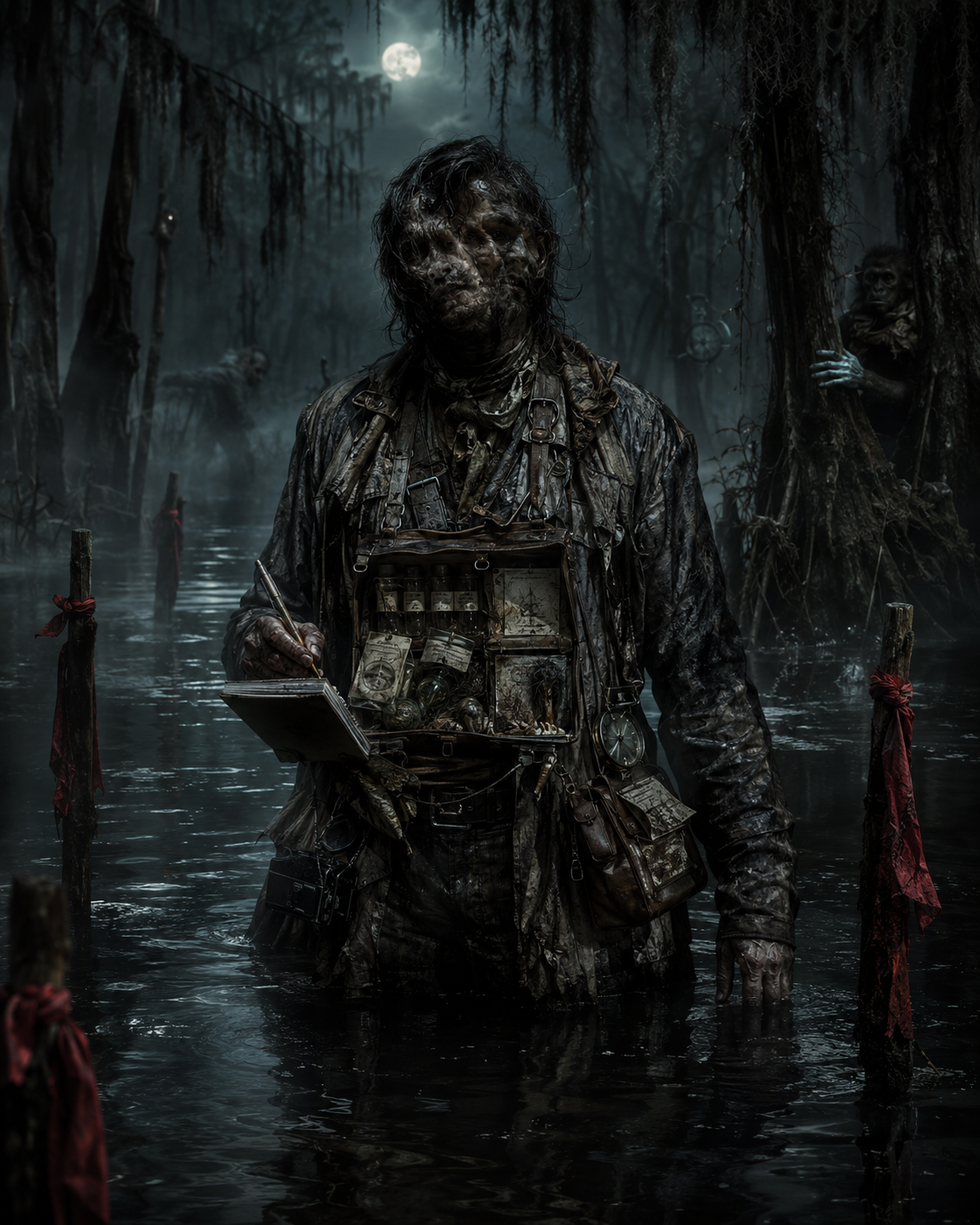
A strip of faded red cloth had been tied near the top.
A small brass plate was nailed beneath it.
Elias crouched.
The plate read:
POINT 1
JULY 29, 2026
E C
He did not tell Lorna that the initials frightened him.
He examined the plate through a magnifying lens. The letters had not been stamped with a modern press. Their edges were uneven, each groove cut by hand with a narrow chisel.
The work was careful.
Not decorative.
Whoever made the plate wanted the letters to endure.
Lorna waited behind him with one hand resting on the grip of the pistol at her hip.
“You know who put it there?”
“No.”
“You know who might have?”
“No.”
“You have said no twice, but neither one sounded honest.”
Elias returned the lens to his pocket.
“I know the style.”
“What style?”
“Old parish field markers.”
“County markers?”
“Older than the county system.”
Lorna’s expression tightened.
“How old?”
“The earliest plats in this section were mapped with wood stakes and cloth ties. Surveyors carried brass tags when a corner mattered enough to outlive the timber.”
“This is not a corner.”
“I know.”
“Then what is it?”
Elias stood and looked deeper into the pines.
The next strip of red cloth waited between two trunks.
“A line.”
“Property line?”
“No.”
“Timber boundary?”
“No.”
“What kind?”
Elias opened his notebook and wrote the first bearing.
“That is what we are going to determine.”
Lorna looked toward her displaced house, barely visible through the trees.
“We?”
“You called me.”
“I called you to tell me why somebody filled my property with stakes.”
“And I intend to.”
“I did not call you to follow them into the swamp.”
Elias glanced at the brass tag again.
He could have returned to the truck.
He could have photographed the marker, contacted the county, and waited for another crew.
That would have been the reasonable response.
The problem was that another crew would not know this land.
They would not know the old markers. They would not understand that the tree line on modern maps had shifted after the flood of 2009. They would not know the difference between a legitimate iron pin and a piece of scrap driven into wet ground by a logger.
Elias knew.
That knowledge carried responsibility.
At least that was what he told himself.
He took a measurement from the established southern pin.
The new stake sat eleven feet inside Lorna’s legal property.
No reason.
No alignment.
No known easement.
He wrote the distance in his notebook.
A second marker stood farther through the pines.
Then another.
Each carried a brass number.
POINT 2
POINT 3
POINT 4
The red cloth had faded as though exposed for decades, but the wood beneath remained solid.
Elias tested one with a soil probe.
The stake went deeper than expected.
Five feet.
Six.
The probe did not reach the end.
“Who drives a survey stake that deep?” Lorna asked.
“Nobody.”
He looked along the line.
The markers did not follow a boundary.
They curved north into lower ground.
At Point 4, the brass plate listed a bearing that differed from Elias’s compass by less than one tenth of a degree.
He checked again.
Then a third time.
“Accurate?” Lorna asked.
“Extremely.”
“Could somebody have copied your old field notes?”
“The original survey is public record.”
“So yes.”
“The bearings are public. My working corrections were not.”
“What corrections?”
Elias hesitated.
“Twelve years ago the magnetic reading was wrong in this section. Iron deposits under the marsh affected the needle. I corrected the legal bearing using solar observation.”
Lorna pointed at the plate.
“And this matches your correction.”
“Yes.”
“Who knew?”
“My assistant.”
“Name?”
“Calvin Mott.”
“Where is he?”
“Dead.”
The swamp seemed quieter after he said it.
Calvin had died from pancreatic cancer six years earlier. He had worked beside Elias for nearly two decades and possessed an irritating habit of humming hymns while holding a level rod.
Elias could almost hear it now.
A low tune threading through the pines.
He turned.
“What?” Lorna asked.
“Did you hear singing?”
“No.”
The tune continued.
Soft.
Distant.
Calvin’s favorite hymn.
Elias walked toward it.
Lorna caught his sleeve.
“The markers go the other way.”
The humming stopped.
Point 5 stood ahead.
Its brass plate read:
ASSISTANT CONFIRMED
CALVIN MOTT
DECEASED
Lorna stepped away from the stake.
“You are done now.”
Elias stared at the name.
The letters had been engraved years ago. Green oxidation filled their deepest grooves.
Calvin had been alive when the plate was made.
Perhaps.
The thought formed before Elias could stop it.
Perhaps Calvin had helped.
No.
Calvin would have told him.
Unless Calvin had followed the same line alone.
Unless the cancer had not been the first thing killing him.
Elias crouched beside the stake.
Beneath the brass plate, faint scratches marked the wood.
Not random damage.
Words.
He brushed away moss.
DO NOT COMPLETE THE FIGURE
The handwriting looked like Calvin’s.
Elias had seen it on thousands of field cards.
Block letters.
Heavy pressure on the downstrokes.
A habit of leaving the letter G open.
Lorna read over his shoulder.
“Your dead assistant wrote that?”
“I do not know.”
“You know what his writing looked like.”
“Yes.”
“Then say it.”
“It looks like his.”
The red cloth tied near the top of the stake moved.
No wind touched the trees.
The cloth pointed north.
Toward the next marker.
Lorna raised her pistol.
“At what?”
“I do not know.”
“You keep saying that.”
“Because it remains true.”
The ground behind them clicked.
Elias recognized the sound.
A tripod leg locking into place.
He turned.
No equipment stood there.
Only their footprints.
Lorna’s prints stopped where she stood.
Elias’s continued another twelve feet behind him.
They showed him walking backward along the route they had already traveled.
The copied trail ended beside Point 4.
A third footprint appeared.
Old field boot.
Narrow heel.
Shallow toe.
Then another.
The unseen surveyor walked toward them.
Lorna aimed at the empty trail.
“Elias.”
“I see it.”
The next impression formed closer.
Mud compressed.
Water gathered in the heel.
No foot visible.
Elias’s instincts overruled fear.
He measured the stride.
Thirty one inches.
Consistent.
He wrote it down.
Lorna stared at him.
“You are taking notes?”
“It leaves sign.”
“What does that mean?”
“It means it is real.”
The invisible trail stopped beside Point 5.
The brass tag clicked.
A new line appeared beneath Calvin’s name.
ASSISTANT REPLACEMENT REQUIRED
Elias closed the notebook.
For the first time that morning, he considered leaving.
Then another plate struck metal deeper in the woods.
A small clean sound.
Like a survey hammer setting a point.
The unknown line waited for completion.
Elias had spent his life finishing lines.
The thing in the swamp knew that before it knew his measurements.
They continued.
Point 8 listed the next distance.
Point 9 listed the bearing.
Point 10 listed a date.
AUGUST 2, 2026
Point 11 listed a time.
4:17 PM
Point 12 listed a name.
ELIAS CROWE
Lorna read it over his shoulder.
“We are done.”
Elias photographed the plate.
“This could be somebody who knows I was coming.”
“You told nobody.”
“I told my wife.”
“Your wife does not sneak through marshland carrying brass tags.”
Elias examined the stake.
The nails were square cut.
Old.
Rust filled the wood around them.
“This was placed years ago.”
“Then how did it know today?”
He did not answer.
Point 13 stood beside a wide cypress.
The plate read:
HEIGHT
71 INCHES
Elias stood slowly.
He was five feet eleven.
Point 14:
SHOULDER WIDTH
18.4 INCHES
Point 15:
LEFT ARM
25.1 INCHES
Lorna stepped backward.
“These are your measurements.”
Elias tried to laugh.
His mouth had gone dry.
Point 16 listed his chest circumference.
Point 17 listed the length of his right leg.
Point 18 listed a scar beneath his left knee.
Not the measurement.
The scar.
OLD CHAINSAW INJURY
1998
Lorna grabbed his sleeve.
“Leave.”
The compass needle no longer moved.
It pointed deeper into the swamp.
Elias closed the instrument.
He had built his life around the belief that lines mattered.
A line separated ownership from trespass.
True bearing from guessing.
Measured fact from fear.
The stakes were facts.
Whatever else they were, they had been placed precisely.
He could not leave a line unfinished.
“Just one more.”
Lorna swore at him.
Elias continued.
Point 19 stood in a clearing.
No trees grew within twenty feet.
The ground had been dug into a perfect square.
Six feet long.
Three feet wide.
Five feet deep.
A grave.
At its center stood a taller stake.
Red cloth moved despite the still air.
The brass plate read:
POINT ESTABLISHED
ELIAS CROWE
DEPTH 60 INCHES
Lorna shouted his name.
Something struck the back of Elias’s knees.
He fell forward.
The grave opened beneath him.
He did not land at the bottom.
Wooden rods rose from the soil and caught his body.
One beneath each arm.
One against his spine.
One behind his skull.
His joints turned.
Not tearing.
Adjusting.
His legs spread into rigid angles.
His arms locked outward.
His head tilted toward the northern line.
Lorna heard his shoulder break.
Then the other.
Elias screamed once.
The rods lifted him upright.
His feet did not touch the ground.
A brass compass pushed through the mud beneath his chest.
Its needle spun toward his heart.
Lorna stumbled to the edge.
Elias looked at her.
His eyes remained clear.
“Do not remove the stake.”
She reached for him.
His fingers closed around two measuring rods.
“Point established,” he said.
Lorna ran.
Harper Pike arrived before noon.
Lenora rode beside her in the parish utility vehicle, one hand on the dashboard as the tires struck ruts.
Age had narrowed Lenora’s shoulders but had not softened her face. Her silver hair had been cut short, and the old sheriff’s badge no longer rode at her hip.
The shotgun did.
Owen sat behind them.
He had not wanted to come.
Lorna’s call changed that.
New survey stakes had appeared fifty yards from his property the previous night.
Each carried his name.
The ride from the parish road to the first marker took nearly twenty minutes.
Nobody spoke for the first five.
Owen sat behind Harper with both hands clasped between his knees. He had grown taller than Lenora, lean and strong from construction work, but the trail reduced him to the boy who had once followed false prints toward Cypress Bend.
Harper saw it in the mirror.
His eyes moved constantly.
Ground.
Trees.
Water.
Back trail.
Never resting in one place.
Lenora noticed too.
“You do not have to go all the way in,” she said.
Owen looked toward the road behind them.
“Yes, I do.”
“No, you do not.”
“The markers are beside my property.”
“That does not make them yours.”
“They have my name.”
“That still does not make them yours.”
Owen leaned forward.
“What happens when the next one appears beside my bedroom?”
Harper kept her eyes on the road.
“We remove it.”
“And when it comes back?”
“We remove it again.”
“And when the house moves?”
Lenora said nothing.
Lorna Dace’s farmhouse remained visible through a gap in the trees.
Even from the vehicle, Harper could see something wrong with its position. The porch faced the cypress pond, but the driveway ended behind the structure. Electrical lines stretched at strange diagonal angles. A water pipe rose from bare soil two hundred feet from the kitchen and continued across the grass without sagging.
The land had accepted the house’s new position as if it had always stood there.
Harper slowed.
“Did the House Under Blackwater ever move buildings above ground?” Owen asked.
“June said it learned rooms,” Lenora replied.
“That is not an answer.”
“It is the only one I have.”
Harper studied the farmhouse.
“No porch light.”
Owen looked at her.
“What?”
“The House always used light. Camp Nine rebuilt around invitation. Doors. Windows. Rooms people remembered.”
“This one?”
“This feels different.”
Lenora followed the stretched power line with her eyes.
“Boundary.”
Harper nodded.
“The building did not choose a new location. Something moved the legal point underneath it.”
Owen exhaled.
“Wonderful.”
They found Lorna beside the first marker.
Mud covered her knees.
She held a rifle but had forgotten to load it.
“He is alive,” she said.
Lenora climbed down slowly.
“Who?”
“Elias.”
“Where?”
Lorna pointed.
Harper studied the trail.
The markers continued into the marsh.
Fresh prints moved between them.
Elias’s work boots.
Lorna’s rubber soles.
A third set.
Long narrow heel.
Old leather tread.
The unknown prints appeared only beside the stakes.
No approach.
No departure.
“Someone followed them,” Harper said.
Lorna shook her head.
“Nobody.”
Owen crouched beside the nearest third print.
“Wrong pressure.”
Harper looked at him.
He pressed two fingers into the mud.
“The heel is deep, toe is shallow. Whoever made it was leaning backward while moving forward.”
Blackwater Tracks had taught Owen things no child should have learned.
He stood.
“It is not the Walker.”
“You sure?” Lenora asked.
“No.”
That answer satisfied Harper more than certainty would have.
They followed the markers.
At Point 12, Harper saw Elias’s name.
At Point 18, the scar.
At Point 19, she smelled blood.
The grave waited in the clearing.
Elias remained suspended above it.
His joints had been aligned with rods until his body resembled a survey tripod.
His hands gripped measuring poles.
A compass sat against his chest.
The central stake passed between his boots and disappeared into the earth.
For several seconds nobody understood what they were seeing.
The body looked less like a victim than an instrument.
That was worse.
Elias’s eyes moved toward Harper.
“Point established.”
Lorna made a sound like an animal struck in the dark.
Harper forced herself to study the construction.
Root rods beneath the arms.
Support behind the spine.
Compass aligned against the sternum.
Red markings across the joints.
The arrangement had not been improvised.
It followed a plan.
“He is a tripod,” Owen whispered.
“No,” Harper said.
She looked at the central stake.
“He is a monument.”
The word caused Elias to blink.
Something inside him recognized it.
Lenora approached from the side.
“Elias, can you hear me?”
“Point established.”
Owen stared at the rods.
“They are growing.”
Harper saw thin fibers enter Elias’s clothing.
Not puncturing him.
Measuring him.
Red marks had been painted across his skin.
Small labels appeared beside each.
LEFT HUMERUS
RIGHT FEMUR
SPINAL DEFLECTION
RESPIRATORY RESPONSE
Lenora raised the shotgun.
“Where do I shoot?”
Elias spoke in his own voice.
“Do not remove the stake.”
Harper moved to the grave’s edge.
“What happens if we do?”
His mouth opened.
A different voice emerged.
Older.
Male.
Calm.
“Survey point fails.”
“Who are you?”
“Observer.”
“Where are you?”
The compass needle swung toward the trees.
A man stood between two cypress trunks.
Canvas field jacket.
Wide brimmed hat.
Notebook in one hand.
Polaroid camera in the other.
His face remained shadowed.
Harper saw gray beard.
Then no beard.
Then the hard familiar profile of Caleb Ward.
Owen whispered, “Caleb?”
The figure raised the camera.
A flash whitened the clearing.
When Harper’s vision returned, the man was gone.
A square photograph rested on the stake.
The image developed slowly.
Elias hung above the grave.
Harper, Lenora, Owen, and Lorna stood around him.
Behind them waited a fifth person.
Harper.
An older Harper.
Her hair gray.
Her eyes black.
The photographed woman held a brass stake above Lenora’s back.
Harper tore the picture in half.
Elias began convulsing.
The rods tightened.
“Point established,” he repeated.
Lorna reached down and yanked the central stake.
“No,” Harper shouted.
The stake came free.
Elias’s body collapsed inward.
Every joint reversed at once.
His chest struck the rods.
The compass broke beneath his ribs.
He fell into the grave.
Dead before reaching the bottom.
The ground closed around him.
Mud moved from the walls and covered his body.
Within seconds, only the empty square remained.
Lorna held the stake.
Words appeared on the brass plate.
POINT LOST
REPLACE SUBJECT
The red cloth pointed toward her.
Chapter Two
Deputy Mason Rill took the photograph after Lenora ordered everyone to leave the clearing.
He did it quietly.
Harper noticed the movement but not the camera.
Mason was thirty three, broad faced, eager, and burdened with the kind of confidence that came from arriving after the worst part of a tragedy.
He had joined the parish department after Lenora retired. He respected her reputation without understanding how much fear had built it.
He photographed the empty grave.
The rods.
Lorna holding the stake.
The third set of footprints.
He slipped the camera into his evidence bag before Harper turned.
“What did you take?”
“Nothing.”
“Open the bag.”
Mason smiled.
“You are not law enforcement.”
Lenora looked at him.
“I was when your mother still made you wear church shoes.”
He opened the bag.
The instant camera sat inside.
Harper’s face tightened.
“Where did you get that?”
“Evidence locker. Old department issue.”
“Whose?”
Mason checked the faded property tag.
“Research Division transfer. Franklin Mercer estate.”
Owen stepped away.
“Destroy it.”
“It is a camera.”
“It took the photograph.”
“Somebody took the photograph.”
Harper held out her hand.
Mason removed the developing print.
The image showed the grave.
Mason stood near the edge.
Yet he had been behind the camera.
In the photograph, another version of him waited thirty yards deeper in the trees.
Harper took it.
A second image slid from the camera by itself.
Mason stood farther away.
A third followed.
His body was smaller.
Deeper along the line of markers.
Then a fourth.
Mason faced the camera from the far end of a cypress tunnel.
His eyes had been replaced by round brass compass lenses.
Owen whispered, “Do not follow it.”
Mason looked embarrassed rather than afraid.
“Somebody prepared these.”
“With your face?” Harper asked.
“Deepfake.”
“On instant film?”
“Costume.”
Lenora took the camera.
The shutter fired beneath her hand.
A new photograph developed.
Mason stood alone beside black water.
Behind him, the field researcher wrote in a notebook.
A label had been placed beneath Mason’s feet.
DIRECTIONAL RESPONSE
TRIAL 1
Mason grabbed the image.
“This is a threat.”
“No,” Harper said. “It is a plan.”
The unknown footprints led east.
Mason stared after them.
“We can catch him.”
“That is why he left the trail.”
“You expect me to let somebody walk away after killing Elias?”
Lenora stepped closer.
“I expect you to understand when a path wants you on it.”
Mason laughed.
“That is not police work.”
“No,” Lenora said. “It is staying alive.”
Mason took the images home.
He did not record them in the evidence log.
That detail became important later.
If he had entered the camera and prints into the department system, someone might have noticed the changing sequence. Someone might have called Harper or Lenora before he left.
Instead, Mason spread the photographs across his kitchen table.
His wife, Renee, had taken their daughter to visit family in Beaumont. The house felt too quiet without them. The refrigerator hummed. The wall clock clicked.
In the first photograph Mason stood beside Elias’s grave.
In the second he waited among the trees.
In the third he was deeper along the trail.
He arranged them by apparent distance.
Each image had been taken from the same camera position.
The grave remained centered.
Only Mason moved.
The final picture showed him beside black water with brass lenses where his eyes should have been.
He turned it facedown.
The camera sat near the table’s edge.
Old department issue.
Heavy plastic body.
Fixed flash.
A faded strip of adhesive on the bottom carried Franklin Mercer’s initials.
Mason had heard the stories.
Everyone raised in Blackwater Parish had.
Franklin and the original Research Division.
Camp Nine.
Swamp Monkeys.
The Mercer family curse.
Mason had treated them the way most local deputies treated stories told after midnight. He listened because witnesses needed to speak. He wrote what they said. Then he translated fear into practical language.
Unidentified animal.
Trespasser.
Environmental exposure.
Trauma response.
He had never mocked Lenora directly.
But he had privately believed age and grief had turned her cautious beyond usefulness.
The camera shutter clicked.
Mason looked up.
A new photograph slid from the front.
He did not touch it until the image developed.
Renee stood in their bedroom.
Their daughter slept beside her.
Behind the bed, the field researcher wrote in a notebook.
Mason grabbed his phone and called.
Renee answered on the third ring.
“What happened?”
“Where are you?”
“At Mama’s. Why?”
“Put Amelia on.”
“She is asleep.”
“Wake her.”
“Mason.”
“Wake her.”
He heard movement.
His daughter’s tired voice came through.
“Daddy?”
He closed his eyes.
“You okay?”
“Yes.”
“You see anybody outside?”
“No.”
“Keep the curtains closed.”
Renee took the phone.
“You are scaring her.”
“Lock every door.”
“They are locked.”
“Do it again.”
She paused.
“What did you find today?”
Mason looked at the photograph.
The researcher had moved closer to the sleeping child.
“Nothing.”
“You are lying.”
“I need to work something out.”
“Call Lenora.”
The suggestion angered him.
Not because it was wrong.
Because it was correct.
“I am a deputy.”
“And she spent thirty years seeing things you have spent three pretending are animal calls.”
“I do not pretend.”
“Then call Harper.”
He ended the call.
The camera fired again.
New photograph.
Mason stood in front of the Dace property marker.
A handwritten note appeared across the bottom.
OFFICER REQUESTS INDEPENDENT CONFIRMATION
Mason stared.
The next image emerged.
RESPONSE APPROVED
He should have gone to the department.
Instead, he holstered his pistol.
Packed a flashlight.
Took the camera.
The thing had threatened his family.
That was how he understood it.
In truth, it had measured him.
Pride.
Professional insecurity.
Protective instinct.
His need to prove he was capable of handling what Lenora had survived.
The Last Researcher had not merely shown him a trail.
It had identified the exact reason he would follow alone.
At the drainage canal, Mason found another photograph pinned to a tree.
It showed Lenora standing behind him.
He turned.
Empty woods.
The next showed Harper.
Then Owen.
Then his daughter.
Each person appeared closer.
Each had black water running from the eyes.
Mason raised the camera.
The viewfinder framed the path.
A red survey stake stood where none had been moments earlier.
The brass plate read:
SUBJECT MOTIVATED BY PROTECTION
DIRECTIONAL RELIABILITY UNKNOWN
Mason ripped it from the ground.
The earth beneath it made a deep clicking sound.
Compass calibration.
The instrument hanging from the branch began spinning.
He followed because somewhere behind fear, Mason still believed there was a correct direction.
A north.
A suspect.
A location.
An arrest.
The trail ended at a pool of black water.
Mason’s photographs floated across the surface.
One by one.
He waded after them.
Water reached his knees.
Then his waist.
A man stood on the opposite bank.
Field jacket.
Camera.
Notebook.
Mason drew his pistol.
“Sheriff’s department.”
The man wrote something.
“What is your name?”
No reply.
Mason moved closer.
The man’s face changed.
Franklin Mercer.
Amos Bell.
Silas Creed.
Caleb Ward.
Mason.
The final face belonged to Harper.
“You want me to follow?” Mason asked.
The researcher pointed at the compass.
The needle turned toward Mason’s chest.
Two roots rose from the water.
They touched his eyes.
The body camera fell sideways.
Mason screamed for twelve seconds.
Then stopped.
When Harper and Lenora found him the next morning, he stood neck deep in the canal.
His eyes were gone.
Brass compass lenses filled the sockets.
The needles inside them moved whenever someone spoke.
North when Harper spoke.
East when Lenora spoke.
South when Owen spoke.
West when Lorna spoke.
“Mason,” Harper said.
His head turned north.
“Mason, come toward me.”
He tried.
The eyes directed him east.
His body followed.
He stepped into deeper water.
Lenora waded after him.
His head snapped west when Lorna shouted.
He turned away from Lenora.
Harper realized what the researcher was measuring.
“Stop talking.”
Everyone fell silent.
Mason stood still.
The compass needles spun.
No human voices to orient against.
Harper entered the water.
She reached him.
The brass lenses clicked.
Her own heartbeat sounded through them.
Mason whispered, “Direction unknown.”
The field researcher appeared in the reflection between them.
Not on the bank.
Only in the water.
He wrote in the notebook.
Mason’s compass eyes settled downward.
His body plunged beneath the surface.
Harper caught his shirt.
Something below pulled harder.
Lenora grabbed Harper.
Owen joined them.
For one second Mason rose high enough to breathe.
Then the brass lenses turned black.
His weight doubled.
The canal took him.
The water closed without ripples.
A red survey stake surfaced.
Its plate read:
COMPASS CALIBRATED
SUBJECT FAILED RETURN TEST
Harper carried the stake back to the vehicle.
Lenora watched her.
“What are you doing?”
“Evidence.”
The word sounded wrong as soon as Harper said it.
Owen heard the echo too.
“June said that.”
Harper looked at him.
“I know.”
“Then put it down.”
Harper dropped the stake.
The field researcher’s footprints appeared around it.
One complete circle.
Then nothing.
Chapter Three
The markers spread across Blackwater Parish over the next four days.
They appeared beside roads.
Inside fenced pastures.
At abandoned camps.
Behind churches.
Along drainage ditches.
Some carried coordinates.
Others names.
A few bore dates that had not occurred.
People pulled them.
Burned them.
Cut them with chainsaws.
The stakes returned.
Sometimes in greater numbers.
Lorna Dace removed forty three from her property.
She stacked them inside her barn and soaked them with diesel.
The pile burned for six hours.
The brass plates remained.
That night, Lorna’s farmhouse shifted several hundred feet without damaging its foundation.
Her daughter called Harper at 2:11 in the morning.
The family had gone to bed facing the pasture.
They woke facing the cypress pond.
The front porch steps descended into black water.
The power lines stretched across two hundred feet of empty land without breaking.
The plumbing still worked.
The foundation had moved beneath the house.
Every room remained intact.
Except one.
A narrow space had appeared between Lorna’s bedroom and the kitchen.
No door led into it.
Tapping came from behind the wall.
Harper arrived with Lenora and Owen.
Lorna’s husband stood outside holding an axe.
His two grandchildren sat in the truck.
“Where is she?” Harper asked.
He pointed at the house.
“She went to find the tapping.”
The interior smelled of red paint.
Lines had been drawn across the walls.
Measurements.
Bearings.
Distances to property corners.
The hallway contained six more feet than the exterior should allow.
Harper measured twice.
Owen did not.
“The house is making a record room,” he said.
They found the new wall beside the kitchen.
Five fingertips protruded through the paneling.
Red paint stained each nail.
Tap.
Pause.
Tap tap.
Pause.
Tap.
“Lorna?” Harper asked.
The fingers moved.
Tap tap tap.
Lenora pressed her ear to the wood.
A voice spoke inside.
“East boundary.”
Harper tore away the panel.
No cavity.
Only old survey documents packed tightly between studs.
Deeds.
Plats.
Boundary disputes.
Tax maps.
Records dating back more than a century.
Lorna’s face had been pressed among the paper.
One eye visible.
Mouth covered by a property map.
Her body ran upright inside the wall.
Flattened impossibly thin.
Alive.
Harper pulled at the papers.
Roots held them together.
Lorna’s fingers tapped.
North.
East.
South.
West.
Again.
Owen found a red stake beneath the kitchen table.
Its plate read:
BOUNDARY ARCHIVE
SUBJECT ACTIVE
Lenora took the axe from Lorna’s husband.
“Everybody out.”
“What are you doing?” he asked.
“Opening the wall.”
She struck.
The paneling split.
The entire house groaned.
Every window showed black water.
Though the structure stood on dry land.
Lenora struck again.
Lorna screamed from within the wall.
Not from pain.
Warning.
“Do not move the line.”
The hallway extended behind them.
New doors appeared.
One opened into Camp Nine.
A yellow porch light glowed underwater.
Another opened onto Dead Man Slough.
Faces waited among roots.
A third showed the Bell Trees.
The house was not the House Under Blackwater.
Not fully.
It was learning the method.
The survey had connected Lorna’s home to the old architecture.
Harper grabbed the axe.
She struck around the protruding hand.
Paper peeled away.
Lorna’s arm emerged, stretched flat as cloth.
Her husband sobbed.
Harper cut deeper.
The red survey lines across the walls began shifting.
They converged on Lorna.
Her fingertips tapped faster.
Owen shouted, “The stakes.”
Outside, forty three brass plates rose from the ashes beside the barn.
Each reflected firelight that no longer burned.
The house moved another thirty feet toward the pond.
The porch entered water.
Harper understood.
The property boundary was dragging the house toward the mapped line.
Lorna had become the record defining it.
“Burn the wall,” she said.
Her husband stared.
“She is inside.”
“It is keeping her alive.”
“That is my wife.”
Lorna’s eye moved toward him.
Tears slid sideways across the paper.
She tapped one final pattern.
Long.
Short.
Short.
Long.
Her husband recognized it.
Their old gate code.
The one she used when she wanted him to come home.
He lowered his head.
Lenora poured lamp oil along the wall.
The flame spread quickly.
Documents curled.
Roots writhed.
Lorna screamed once.
Then the tapping stopped.
The house settled.
Outside, the porch withdrew from the pond.
Not moving backward.
The land beneath it reappeared.
By sunrise, the narrow room had vanished.
The farmhouse stood where it had originally been.
The wall contained only burned studs.
No body.
No records.
One brass plate lay in the ashes.
BOUNDARY CLOSED
The field researcher watched from the far side of the pond.
Lorna’s husband raised his rifle.
Harper stopped him.
“Do not give it another measurement.”
“What?”
“Distance. Angle. Shot placement. That is what it wants.”
The researcher lifted the Polaroid camera.
Harper turned away before the flash.
Chapter Four
Warren Cade had spent fifteen years calling the Research Division a family business built on fear.
He said Franklin Mercer exaggerated tracks to keep outsiders from hunting near Camp Nine.
He said Amos Bell mistook settling roots for intelligent knocking.
He said Dead Man Slough was methane, decay, and guilty memory.
He said the Lowland Man was a bear, the Listener was a sinkhole, the Walker was staged sign, and the House Under Blackwater was mass hysteria sharpened by grief.
Then Warren saw Elias Crowe’s grave.
He saw Mason Rill’s compass eyes.
He saw Lorna Dace’s house return to its original foundation after a wall burned.
Belief did not humble him.
It excited him.
He began collecting samples.
The first was a tuft of black hair caught on a cypress beside one of the survey stakes.
Harper told him to leave it.
Warren bagged it.
The second was a strip of root tissue found near Dead Man Slough.
He labeled it.
The third was a section of pale wood taken from a ruined Bell Tree.
Ruth Bell nearly struck him when she learned.
“You do not cut from those trees.”
“I took dead material.”
“You do not know what dead means there.”
Warren smiled.
“That is what analysis determines.”
Ruth was Amos Bell’s great niece.
She had inherited none of his patience for mystery.
Her family land sat three miles from the old Bell Trees. She maintained instruments on several younger cypress trunks, measuring resonance and groundwater pressure.
Not because she wanted to continue Amos’s work.
Because she wanted warning.
One knock meant passing.
Two meant direction.
Three meant location.
Anything after that was practice.
Ruth had carved the rule into the workbench inside her barn.
Warren read it and laughed.
“Folklore presented as procedure.”
Ruth looked at Harper.
“Why is he here?”
“Because the survey line crosses protected wetlands.”
“No. Why is he still breathing near my trees?”
Warren placed his sample case on the bench.
“Because unlike your uncle, I intend to document this properly.”
The barn knocked once.
Everyone stopped.
The sound came through the foundation.
One deep blow.
Ruth turned off the overhead fan.
Second knock.
Closer.
The metal tools hanging on the wall vibrated.
Third knock.
Directly beneath Warren’s sample case.
A fourth rhythm followed.
Tap.
Tap.
Tap.
Tap.
Even spacing.
Survey hammer.
Ruth’s face changed.
“That is new.”
Warren opened the case.
Every sample had moved.
Hair.
Root.
Wood.
Mud from Blackwater Tracks.
A rusted nail believed to come from Camp Nine.
They formed a circle around a small brass plate.
FIELD KIT COMPLETE
Warren whispered, “It brought them together.”
Harper grabbed the plate with a rag.
The text changed.
ASSISTANT CADE
REPORT TO STATION
Warren smiled.
“Station.”
“No,” Harper said.
“You saw it.”
“I saw bait use your name.”
“You keep calling everything bait because you are afraid of where it leads.”
Harper stepped close.
“I call it bait because it knows what hungry things eat.”
Warren took the case.
He left before dark.
Warren did not begin as a fool.
That was what made him dangerous.
He catalogued every sample using clean instruments and separate containers. He photographed the collection points. He wrote weather conditions, coordinates, times, and handling procedures. He refused to label anything by folklore until laboratory testing eliminated ordinary explanations.
For the first two days, his discipline impressed Harper.
On the third, the samples began rewarding him.
The black hair yielded no known animal DNA.
The root tissue contained nerve like structures despite having no recognizable animal cells.
The Bell Tree fragment vibrated inside a sealed case when a hammer struck steel half a mile away.
The wet floorboard remained damp inside a climate controlled room but never lost measurable mass.
Warren called Harper after midnight.
“You need to see this.”
“No.”
“You have not asked what.”
“That is why I said no.”
“The material is connected.”
“I know.”
“No. I mean physically. The samples react when placed near one another.”
Harper sat upright in bed.
“What did you combine?”
“Nothing. Separate containers. Same table.”
“Move them apart.”
“They arranged themselves.”
Her stomach tightened.
“How?”
“The cases shifted.”
“Warren.”
“I recorded it.”
“Destroy the recording.”
He laughed softly.
“You really are afraid of proof.”
“I am afraid of proof that behaves like bait.”
“Everything is bait to you.”
“No. Food is bait when there is a hook in it.”
He went quiet.
Then said:
“I have spent fifteen years being wrong.”
Harper heard something beneath the admission.
Shame.
Not scientific curiosity.
Warren had dismissed people publicly.
Families of the dead.
Survivors.
Lenora.
June.
Ruth Bell.
Now the evidence did more than challenge his conclusions.
It accused him.
“You want to correct the record,” Harper said.
“Yes.”
“That is what it is using.”
“It is giving us access.”
“It is giving you forgiveness.”
The silence lasted longer.
Warren ended the call.
The following morning he found the first complete Lowland Man track near the Mercer basin.
It appeared in dry clay beneath an overhang where rain could not reach.
Every toe.
Dermal ridge.
Scar across the outer heel.
Perfect.
Too perfect.
Beside it stood a small evidence flag.
Specimen number already assigned.
LM 001.
Warren knelt for three hours creating a cast.
The field researcher watched from the opposite ridge.
When Warren noticed, he did not retreat.
He waved.
The researcher raised one hand in return.
That gesture mattered more to Warren than any sample.
Recognition.
One investigator acknowledging another.
Harper found his notes later.
He had stopped calling the figure a threat.
He referred to it as the Senior Observer.
Over the following days, he found things no one else could.
A perfect Lowland Man track near the Mercer basin.
A section of flooring wet with black water.
A tape containing Amos Bell’s voice.
A clay impression of the Walker’s hand.
Each discovery waited near a survey marker.
Each marker directed him to another.
Warren began drawing a map.
Harper watched the lines connect.
Camp Nine.
Dead Man Slough.
The Bell Trees.
The Walker trail.
The Lowland basin.
The shape emerging across the parish resembled the Research Division emblem.
Two cypress corridors.
A crouched figure between them.
Warren believed it was coincidence.
Then he found the field desk.
It stood in a clearing beyond the old firebreak.
Wooden chair.
Canvas shelter.
Sample trays.
Labels.
A notebook opened to a blank page.
The Last Researcher waited across from him.
Warren saw Franklin Mercer’s face.
Then Amos Bell.
Then himself.
The researcher placed five samples on the table.
Black hair.
Root tissue.
Bell wood.
A wet floorboard.
A cast track.
A handwritten card asked:
IDENTIFY SPECIMEN 1
Warren lifted the hair.
“Swamp Monkey.”
The researcher wrote.
INCORRECT
Something vanished from Warren’s mind.
He stared at the hair.
His wife’s name was gone.
He knew he had been married.
Could picture the ring.
Could not remember her.
The second sample was root tissue.
“Dead Man Slough.”
INCORRECT
His childhood home disappeared from memory.
Third.
Bell wood.
“The Listener.”
INCORRECT
He forgot his daughter’s face.
Warren began to panic.
The researcher presented the wet floorboard.
“Camp Nine.”
INCORRECT
His own name weakened.
He reached for the notebook.
“Who are you?”
The researcher pointed to the final sample.
A strip of cloth from Warren’s field jacket.
Warren stared at it.
The answer should have been simple.
He could not remember wearing the jacket.
Could not remember arriving.
Could not remember the word for cloth.
“Unknown,” he whispered.
The researcher wrote:
CORRECT
The test had never been identification.
It was confession.
When Warren answered Swamp Monkey, the researcher marked him incorrect because the specimen was not merely hair.
It was his dismissal of the witness who found it.
When he answered Dead Man Slough, he ignored the person whose memory had been copied.
When he answered Listener, he reduced Mara Bell’s sacrifice to taxonomy.
Every wrong answer removed a personal memory because Warren had spent years separating evidence from the people it harmed.
The researcher taught him his own method.
Strip context.
Remove identity.
Label remains.
Harper found him seated at the desk before dawn.
His body had been catalogued.
Hair removed into an evidence envelope.
Several teeth labeled by position.
Fingernails bagged.
Buttons cut from clothing.
Bootlaces coiled.
No blood.
No visible violence beyond what had been collected.
Warren breathed.
Harper touched his shoulder.
He recoiled.
“Who are you?”
“Harper.”
“Is that a place?”
“No.”
“What is this?”
He looked at his own hand as though seeing an animal.
The notebook lay open.
SUBJECT: UNIDENTIFIED WITNESS
MEMORY REDUCED TO OBSERVABLE STATE
Warren died before noon.
His heart forgot its rhythm.
Chapter Five
Ruth Bell began vibrating three nights later.
The survey hammer sounded beneath her house at 11:46.
Four evenly spaced blows.
She remained in bed.
The old rules did not cover four.
At midnight, her rib cage answered.
One tremor.
Then another.
Her teeth clicked.
The water glass beside the bed rippled.
Ruth sat up.
The vibration moved through her sternum.
Not pain.
Recognition.
Something beneath the ground had matched her heartbeat.
She called Harper.
By the time Harper arrived, every nail in Ruth’s house had begun humming.
Lenora waited outside with Owen.
The white handed Swamp Monkey stood near the tree line.
Harper saw it clearly for two seconds.
Broad chest.
Dark wet coat.
One pale hand resting against a cypress.
It looked toward Ruth’s house.
Then toward the survey stake beside the porch.
It crossed the yard without sound.
Gripped the marker.
Pulled.
The stake did not move.
The Swamp Monkey braced both feet.
Muscles tightened across its back.
Still the marker held.
Something knocked below.
The animal released it and retreated.
Not afraid.
Calculating.
It picked up a stone and smashed the brass plate.
The plate bent.
The stake remained.
The Swamp Monkey looked at Harper.
Then covered its own ears.
Ruth screamed inside.
They entered.
She stood in the kitchen gripping the table.
Her chest vibrated visibly.
Each pulse made the cabinet doors knock.
“The Bell Trees,” she said.
“What about them?” Harper asked.
“It is using one.”
“Who?”
“The researcher.”
Another pulse bent Ruth backward.
Owen caught her.
“Get her away from the house.”
Ruth shook her head.
“It is not the house. It has my rhythm now.”
They drove toward the Bell property.
The vibration followed.
Road signs hummed as they passed.
Fence wire sang.
Water in ditches trembled.
At the old grove, the Last Researcher stood before a Bell Tree.
He held a survey hammer against the trunk.
Every time he struck, Ruth’s chest answered.
The tree’s bark had been marked with measurements.
RESONANCE
THORACIC RESPONSE
DISTANCE OF TRANSMISSION
Ruth stepped from the vehicle.
Harper grabbed her.
“I have to break the rhythm.”
“You cannot go closer.”
“I know these trees.”
“That thing knows you know them.”
Ruth carried a heavy wooden mallet.
She moved between the cypress roots.
The researcher struck.
Ruth struck another trunk out of sequence.
The grove answered.
Different rhythms collided.
Water jumped from the ground.
Roots shifted.
A deep sound rolled beneath the swamp.
The Listener.
Not fully awake.
Turning.
The researcher struck again.
Ruth changed the pattern.
The tree copied her heartbeat.
She accelerated.
The vibration within her intensified.
Harper saw roots rising behind Ruth.
“Move.”
Too late.
The roots wrapped around Ruth’s ribs and lifted her against the trunk.
Her back struck the bark.
Arms pinned.
Chest exposed.
The Last Researcher approached.
It placed one hand against her sternum.
Its fingers changed.
Amos Bell’s hands.
Old.
Scarred.
Listening.
Ruth screamed at the face above her.
“You are not him.”
The researcher wrote with the other hand.
SUBJECT DISTINGUISHES MEMORY FROM IDENTITY
The roots tightened.
Ruth’s rib cage vibrated like a drum.
The sound traveled through every tree.
Harper rushed forward.
The white handed Swamp Monkey dropped from the branches.
It struck the Last Researcher across the shoulder.
The body folded sideways.
Not bone.
Pages.
Clothing.
Roots.
Several faces moved through its head.
The animal tore the hammer away and snapped it.
The grove erupted with knocking.
One.
Two.
Three.
Hundreds of trees.
The Listener had found every direction at once.
Owen and Harper cut Ruth free.
The Swamp Monkey covered the Bell Tree with its body while the researcher reformed beyond the roots.
The animal looked at Harper.
One pale hand pressed against the tree.
The other pointed toward the road.
Leave.
They carried Ruth out.
She survived for six days.
Survival was not the same as rescue.
The hospital placed her in a basement room because the upper floors carried too much vibration.
Elevators.
Air handlers.
Rolling carts.
Footsteps.
The basement had concrete walls and no windows.
It helped for six hours.
Then the water pipes began knocking.
Harper remained beside her through the first night.
Ruth lay flat with sandbags packed around her chest. Sensors had been removed because the monitor alarms caused her ribs to answer.
Every sound became dangerous.
A nurse dropped a pen in the hallway.
Ruth’s sternum jumped.
A door closed two rooms away.
Her teeth struck together.
Rain began after midnight.
Each drop against the ventilation hood created a faint tremor beneath her skin.
Harper sat motionless.
Ruth opened her eyes.
“You breathe loudly.”
“Sorry.”
“I am joking.”
“You should save your strength.”
“For what?”
Harper looked away.
Ruth smiled.
“That is the problem with researchers. Even when the experiment is over, they keep pretending another result may come.”
“I am not a researcher.”
“No?”
“No.”
“You followed the markers.”
“To stop them.”
“You recorded the plates.”
“To understand the pattern.”
“You interviewed Lorna.”
“To find Elias.”
“You kept Warren’s notes.”
Harper faced her.
“You think I am becoming it.”
“I think it chooses people who can explain why continuing is responsible.”
A tremor moved through Ruth.
The bed frame hummed.
Harper steadied the sandbags.
“Amos thought listening protected people,” Ruth continued. “Maybe sometimes it did. But eventually every sound became an invitation.”
“You are not Amos.”
“No. I was smart enough to dislike him.”
Ruth closed her eyes.
“He loved the mystery more than he loved anyone standing near it.”
Harper thought of June holding the camera while Noah was pulled into black water.
Only one second.
Enough.
“Why did you go to the tree?” Harper asked.
“Because I believed I knew the rules.”
“One. Two. Three.”
“And anything after that is practice.”
“The fourth rhythm was new.”
“No.”
Ruth’s voice weakened.
“The fourth rhythm was for people like me. People who think rules make them safe.”
The wall behind them knocked four times.
Evenly spaced.
Ruth’s body arched.
Harper grabbed her shoulders.
Roots appeared beneath the skin along Ruth’s ribs.
Thin dark lines spreading outward from the sternum.
Ruth gasped.
“It is building a transmitter.”
“No.”
“You cannot no your way through everything.”
“I can try.”
“Pike family religion.”
The real Lenora arrived near dawn carrying no weapon.
She had left the shotgun outside.
Sound mattered more than protection now.
Ruth watched her enter.
“You understand.”
Lenora pulled a chair beside the bed.
“I understand what you asked.”
Harper stood.
“No.”
Lenora looked at her.
“You have said that enough.”
“There has to be another method.”
Ruth whispered, “There is always another method until the method becomes another victim.”
Harper walked into the hallway.
She remained close enough to hear their conversation.
Ruth told Lenora where family documents were stored.
Which Bell Trees should never be cut.
Which one had begun producing the fourth rhythm.
She asked Lenora to tell her sister that Amos’s journals should remain buried.
Then she said:
“Do not let Harper turn this into a debt.”
Lenora answered, “She turns everything into a debt.”
“I know.”
“I will try.”
Ruth laughed softly.
Her rib cage answered the sound.
The fourth rhythm began beneath the floor.
Survey hammer.
Measured.
Patient.
Ruth’s heart started matching it.
Lenora closed the door.
Harper stood with her forehead against the concrete wall.
She heard no struggle.
Only Lenora’s low voice.
Then silence.
The monitor flattened three minutes later.
Across Blackwater Parish, every Bell Tree knocked once.
Passing.
Chapter Six
Garland Voss arrived with three cameras, two rifles, a collapsible blind, and enough confidence to supply an expedition twice his size.
He had built a following hunting cryptids across the southern states. His videos used dramatic music, night vision, and titles promising proof nobody else possessed.
He called the survey killings tragic.
Then he called them an opportunity.
Harper refused to meet him.
Lenora threatened to arrest him.
Garland entered the parish anyway.
The Last Researcher welcomed him.
Tracks appeared beside his camp.
Large.
Clear.
Too clear.
Hair caught on a branch at shoulder height.
A handprint marked the hood of his truck.
A distant figure crossed a firebreak at sunset.
Garland filmed everything.
“This is what they did not want you to see,” he whispered into the camera.
The trail led him to an old hunting blind.
Inside, photographs covered the walls.
Garland as a child.
Garland at school.
Garland with his first rifle.
Garland beside his dying mother.
Garland filming his first false creature track.
Images from moments no camera had recorded.
He should have left.
Instead, Garland removed them carefully.
“Historical surveillance,” he told his audience.
The final photograph showed him standing inside the blind.
Same clothes.
Same camera.
Behind him waited the Last Researcher.
Garland turned.
Nothing.
The blind closed.
Wooden walls folded inward like a camera shutter.
His live feed went black.
Harper found the structure the next day.
It was flat.
Two black panels pressed together.
Between them, preserved in a thin layer of clear resin, lay Garland.
Full size.
Flattened.
Eyes open.
Camera held before his face.
Like a field photograph waiting to be developed.
A brass plate beneath him read:
VISUAL EVIDENCE
OVEREXPOSED
Chapter Seven
Marcus Vale joined Owen because friendship sometimes survives common sense.
He knew what happened when Owen was twelve.
Knew about the false tracks.
The hunting camp.
The Walker.
He believed the stories enough to be careful but not enough to stay home when markers appeared beside Owen’s fence.
Two trails began at the same stake.
One carried Owen’s boot prints.
The other Marcus’s.
Neither man had walked there.
Harper arrived before they entered the woods.
“Do not separate.”
Marcus smiled.
“We know.”
Owen did not.
The copied trails crossed repeatedly.
At each crossing, their prints changed direction.
Sometimes Marcus’s tracks became Owen’s.
Sometimes both sets belonged to the same left foot.
The path divided near an old drainage mound.
Harper marked the junction with orange tape.
The tape turned red.
Survey cloth.
The Last Researcher stood ahead on Marcus’s trail.
It wore Owen’s face.
Marcus saw his friend waving.
The real Owen stood behind him.
For less than a second, Marcus looked between them.
The false Owen ran.
Marcus followed.
Harper shouted.
The woods swallowed him.
They heard conversation ahead.
Marcus asking questions.
Owen answering.
Two identical voices overlapping.
Then silence.
Marcus returned an hour later.
Alone.
Blood on his shirt.
“Owen is dead,” he said.
The real Owen stood beside Harper.
Marcus stared at him.
“No.”
Owen whispered, “That is not Marcus.”
The returned man knew everything.
Childhood memories.
Private jokes.
The name of Owen’s first dog.
The night they stole beer from Lenora’s shed.
Harper watched his shadow.
Two shapes stretched behind him.
One human.
One hunched over a notebook.
They did not expose him immediately.
The false Marcus did not behave like a monster.
He complained about mosquitoes.
Asked for coffee.
Rubbed the old scar on his left wrist when nervous.
He knew Owen hated canned peaches and that Harper checked the rear door twice before sleeping.
Every detail was correct.
That was what made the second shadow easy to ignore.
During the first night, they camped in an abandoned church where the survey markers had not yet crossed the threshold.
Lenora slept near the pulpit.
Owen remained awake beside Marcus.
Harper watched from the far wall.
Marcus leaned close to Owen.
“You believe I am me?”
Owen took his time answering.
“I believe you know what Marcus knew.”
“That is not what I asked.”
“No.”
Marcus looked hurt.
Real hurt.
His shoulders dropped.
“You saw it take me.”
“I heard you leave.”
“You did not follow.”
“That is why I am alive.”
The answer cut.
Marcus stared toward the dark windows.
“I would have followed you.”
“I know.”
“Does that make me stupid?”
“No.”
“What does it make me?”
Owen looked at his friend’s face.
“Marcus.”
For a moment, Harper wanted to believe him.
Then Marcus asked:
“Where does Lenora keep the old parish maps?”
The transition was too clean.
Pain to information.
Emotion used as a path.
Owen noticed.
His expression did not change.
“At the courthouse.”
The maps were beneath Lenora’s bed.
Marcus nodded.
“Which room?”
“She does not work there anymore.”
“I meant which courthouse room.”
“You know the building.”
“Remind me.”
Owen smiled.
“No.”
The copy smiled back.
Neither mentioned the question again.
At dawn, three new stakes stood behind the church.
Harper found mud beneath Marcus’s fingernails.
He claimed he had gone outside to urinate.
His boots were dry.
The second night, Harper pretended to sleep.
Marcus rose after midnight.
He removed red cloth from inside his jacket.
Survey strips.
One by one, he tied them to branches behind the camp.
Then he opened his shirt.
The skin along his spine separated.
Wet pages unfolded.
Harper saw the real Marcus within.
A human eye pressed between two layers.
It moved toward her.
The copy closed before she reacted.
Harper lay still until morning.
She did not expose it immediately because killing the shell might kill the person inside.
That delay cost them distance.
It also gave her time to understand what the Last Researcher had made.
The copy was not merely an imitation.
It was a mobile field notebook.
Marcus’s memories formed the text.
His body formed the binding.
The false exterior collected new observations and wrote them into him.
The copy traveled with them for two days.
It asked careful questions.
Where Harper stored maps.
Which markers had been destroyed.
What Lenora remembered from Camp Nine.
Each evening, new survey stakes appeared behind the group.
The false Marcus planted them while everyone slept.
Harper finally confronted him beside an abandoned church.
“Take off your shirt.”
Marcus laughed.
“Why?”
“Because the blood has not dried.”
He looked down.
The stain moved like ink.
Owen raised a shotgun.
The copy smiled.
Its back opened.
Not skin tearing.
Pages unfolding.
The spine separated into a binding.
Roots threaded through layers of wet paper.
Between them lay the real Marcus.
Folded.
Arms pinned against his chest.
Face pressed through one page.
Still conscious.
The copy spoke with his voice.
“FIELD NOTEBOOK ACTIVE.”
Owen fired.
The false body burst into paper, mud, and roots.
Marcus fell out.
Alive for seven minutes.
He could not unfold.
Every bone had been arranged between pages.
Harper held his hand until it stopped moving.
For those seven minutes, Owen spoke to him about ordinary things.
Their first truck.
A fishing trip ruined by rain.
The time Marcus lied to Lenora and forgot she had already called his mother.
Harper did not record the conversation.
The Last Researcher watched from the woods.
Its pencil remained still.
That was the first observation it failed to collect.
Chapter Eight
Dr. Samuel Vane believed folklore was a machine built by repetition.
He had published three books arguing that Blackwater Parish’s legends grew from grief, commerce, inherited guilt, and deliberate local mythmaking.
He did not call witnesses liars.
He called them participants.
When Harper showed him photographs of the original Research Division survey markers, Samuel saw historical value.
When she warned him to stay away, he heard professional territorialism.
He entered the first field camp alone.
The camp stood beneath four ancient pines.
Three bedrolls lay beneath a canvas shelter.
Four metal cups sat on a table.
Names had been carved into the wood.
FRANKLIN
GIDEON
RALPH
SAMUEL
He touched his own name.
The carving was old.
Older than he was.
Journals filled a wooden crate.
Each contained his arguments.
Written in Franklin Mercer’s hand decades before Samuel published them.
Folklore as commercial ritual.
Witness identity shaped through communal expectation.
Creature narratives as boundary enforcement.
Samuel wept.
Not from fear.
Vindication.
He believed he had discovered intellectual ancestry.
The Last Researcher sat across from him.
It opened the oldest roster.
Three names.
A blank line.
Samuel signed.
Every photograph in Blackwater Parish changed.
Franklin, Gideon, Ralph, and Samuel stood outside Camp Nine.
Samuel appeared beside Amos at the Bell Trees.
Samuel watched Cole enter Dead Man Slough.
Samuel stood behind Caleb Ward.
His family photographs changed too.
He vanished.
His wife no longer remembered marrying him.
His university office belonged to another professor.
His books carried no author name.
Harper remembered because she witnessed the signature.
No one else did.
Samuel remained alive in the camp.
But history no longer contained him outside it.
The Last Researcher labeled him:
ORIGINAL MEMBER
RETROACTIVE
Samuel’s wife called Harper while he sat inside the original field camp.
“Do I know you?” the woman asked.
Harper gripped the phone.
“My name is Harper Pike. Your husband contacted me.”
“My husband?”
“Samuel.”
The line remained quiet.
“I am not married.”
Harper looked across the clearing.
Samuel sat at the old table beside the Last Researcher.
He had just written his name into the roster.
“Check your bedroom,” Harper said. “Left side of the closet. Brown jacket with leather elbows.”
“Who is this?”
“Please.”
Footsteps moved through the phone.
Closet door.
Hangers.
The woman breathed sharply.
“There is a man’s coat.”
“His.”
“I do not know any Samuel.”
“Look in the inside pocket.”
Paper rustled.
“A photograph.”
“What is in it?”
“My children. Me.”
“Who else?”
A pause.
“There is an empty space.”
Samuel appeared in the copy Harper had seen days earlier.
Standing beside his wife.
Now the photograph preserved only the gap he had occupied.
Harper looked toward him.
He seemed unaware.
The Last Researcher showed Samuel another journal.
He smiled as though receiving a professional honor.
“Samuel,” Harper called.
He looked up.
“Do I know you?”
The historical absorption had reached him too.
He no longer remembered arriving with Harper.
He recognized only the role being prepared.
Original member.
Researcher.
Author without publication.
Witness without family.
Harper entered the camp.
The air thickened around the table.
Old photographs hung from lines beneath the shelter.
Samuel appeared in all of them.
At Camp Nine.
Dead Man Slough.
The Bell Trees.
Sometimes young.
Sometimes old.
Sometimes standing where no person had been in the surviving image.
“You were not there,” Harper said.
Samuel touched one photograph.
“I was always there.”
“No.”
“The record confirms it.”
“The record changed.”
“Records do not change backward.”
“These do.”
Samuel’s face softened with pity.
“You are experiencing resistance to corrected history.”
Harper looked at the Last Researcher.
Its face had settled into Samuel’s.
Not copying appearance.
Reinforcing authority.
“You argued these stories were constructed,” Harper said.
Samuel smiled.
“I was correct.”
“Then why trust this?”
“Because I now understand who constructed them.”
“Who?”
“We did.”
The word contained belonging.
The Last Researcher had given Samuel what academia never fully offered.
A place inside the origin of the thing he studied.
Not observer.
Participant.
He had mistaken inclusion for truth.
Harper tore the signed roster.
The paper repaired itself.
Samuel cried out.
Every changed photograph blurred.
His wife’s voice remained on Harper’s phone.
“Who are you talking to?”
Harper looked at Samuel.
He was already becoming difficult to focus on.
Edges fading.
Voice quieter.
“Someone who existed,” Harper said.
Samuel heard.
For one second, fear broke through the role.
“Remember me.”
The Last Researcher placed one hand on his shoulder.
The historical photographs steadied.
Samuel’s fear vanished.
“I have always been remembered.”
Harper left before the camp could decide where to place her.
For the rest of the story, she carried Samuel without proof.
That burden sharpened the final temptation.
The complete journal offered to restore him.
Not simply provide answers.
Return a man to history.
Harper’s refusal would therefore cost more than curiosity.
It would mean accepting that preserving every victim was beyond her power.
Chapter Nine
Carlos Reed returned because Harper said the recovered equipment bore Creed markings.
He had survived the House Under Blackwater with a fractured arm and a refusal to discuss rooms.
The moment he saw the survey winch beside the old field station, he recognized it.
“That went down with Camp Nine.”
The machine had been incorporated into a wall of roots and timber.
Hydraulic lines moved like veins.
Creed Recovery labels appeared beneath mud.
Carlos touched the housing.
His left arm broke.
Same location as before.
He fell screaming.
The Last Researcher stepped from the station.
It opened a notebook.
Carlos’s past injuries began repeating.
Broken rib from a truck accident.
Burn across the right palm.
Concussion.
Cut thigh.
Fractured wrist.
Each arrived in order.
No attacker.
His body remembered damage because the researcher called for it.
Harper dragged him away.
Carlos shoved her toward the station controls.
“Destroy the winch.”
She found a release lever fused into the roots.
Carlos crawled back.
He used his good arm to jam a steel bar into the gear housing.
The machine caught him.
Pulled him against the wall.
His body became the final stress test.
Bones broke in measured sequence.
Before dying, Carlos kicked the release.
The winch tore free.
A section of the field station collapsed.
Beneath it, Harper saw the true map.
Survey lines burned into the earth.
The Research Division emblem stretched across the parish.
Every victim occupied a function within it.
Point.
Compass.
Boundary.
Sample.
Signal.
Image.
Notebook.
History.
Stress.
Only one function remained empty.
RESEARCHER.
HARPER PIKE.
Chapter Ten
The station sat at the center of the emblem.
An old timber shelter built around an enormous cypress stump.
No public map showed it.
No road reached it.
The route required three days.
Not because of distance.
Because the swamp kept offering shorter paths.
Every obvious trail led toward a survey stake.
Every bridge placed them farther inside the emblem.
The Swamp Monkeys dismantled what looked safe.
At first Owen believed the animals were trapping them.
A fallen tree blocked the northern route.
A root bridge had been torn apart over the eastern channel.
Orange trail tape disappeared.
The white handed male crossed behind them and covered their footprints with mud.
Lenora leaned against a cypress to catch her breath.
“They are erasing us.”
Harper looked at the ruined bridge.
“They are erasing the route.”
“Difference?” Owen asked.
“If nobody can follow, the survey cannot repeat.”
Owen studied the water.
“Then how do we reach the station?”
“We stop following what remains.”
Harper removed the compass from her pocket.
The needle pointed toward the nearest marker.
She dropped it into the water.
Owen removed the hand drawn map.
Tore it.
Lenora looked at her shotgun.
“That stays.”
Harper almost smiled.
They began navigating by absence.
Where red cloth did not hang.
Where stakes had been broken.
Where the mud had been deliberately disturbed.
The Swamp Monkeys left no guide marks.
They left damage to the guide marks.
Human beings built paths by adding information.
The animals protected the boundary by subtracting it.
Near sunset on the second day, they found a small camp.
Three bedrolls.
Four cups.
Four spoons.
Names carved into the table.
FRANKLIN
GIDEON
RALPH
HARPER
Her name had been cut deeply into old wood.
Owen touched it.
“Could be new.”
“It is not.”
“How can you tell?”
“The tree grew around the carving.”
Lenora examined the fourth bedroll.
Fresh indentation.
Someone had slept there recently.
A notebook rested beneath the blanket.
Harper’s handwriting covered the first page.
DAY THREE
OWEN NO LONGER TRUSTS THE WHITE HAND
LENORA’S LEFT KNEE HAS BEGUN FAILING
I HAVE NOT TOLD THEM THE STATION IS BENEATH US
Harper closed it.
Owen watched her.
“Is any of that true?”
“Your trust?”
“I asked about the station.”
Lenora sat on the bench.
“My knee has hurt since yesterday.”
Harper looked at the ground.
A low mechanical vibration moved beneath the camp.
The station was not directly below.
The journal wanted them to believe it was.
It had recorded a possible version.
A path built from expectations.
Harper threw the notebook into the fire.
The pages screamed in her voice.
The white handed Swamp Monkey appeared beyond the flames.
It watched until the journal burned.
Then turned south.
Not leading.
Simply choosing a direction the false record had not mentioned.
They followed at a distance.
That night they camped without notes.
Without markers.
Without naming their location.
The absence frightened Harper more than any evidence.
She had spent her adult life believing verification prevented repetition.
Now she had to trust memory knowing memory could change.
Owen sat beside her.
“You are trying to remember the route.”
“Yes.”
“Stop.”
“I need to know how to leave.”
“That is what the journal wants.”
“What happens if we cannot get back?”
“Then nobody else can either.”
Harper looked at him.
“You are comfortable with that?”
“No.”
“Then why say it?”
“Because being afraid of the cost does not make the cost wrong.”
June might have said something similar.
Harper did not mention her.
The story already had enough ghosts.
The Swamp Monkeys had dismantled every visible trail by the time they reached the station.
At the edge of the clearing, the white handed male stood before Harper.
Full height.
Older than she expected.
Scars across the chest.
One pale hand.
It placed that hand over Harper’s notebook.
Not taking it.
Covering it.
Then shook its head.
Harper remembered every warning humans had mistaken for mystery.
She released the notebook.
The animal dropped it into black water.
The pages dissolved.
Behind them, Owen said, “Good.”
Lenora stood beside him, breathing hard from the journey.
The Last Researcher waited inside.
Its clothing came from many decades.
Different boots.
Canvas jacket.
Creed harness.
Franklin’s camera strap.
Amos’s field bag.
Caleb’s compass.
Its face changed constantly.
Franklin.
Amos.
Silas.
Warren.
Samuel.
Harper.
Its hands were stained with ink.
Each fingertip carried a different fingerprint.
Its chest opened like a specimen case.
Hair.
Teeth.
Roots.
Wet wood.
Bell fragments.
Track casts.
A folded evidence envelope.
HARPER PIKE.
The researcher offered her a completed journal.
Every answer waited inside.
What remained of Gideon.
What Eli had become.
Why the root bed remembered.
How the Listener hunted.
What the Walker was.
Where the House Under Blackwater moved.
Why the Swamp Monkeys guarded the parish.
Names of every victim.
Locations of every missing body.
Proof.
Harper opened the journal.
The first pages contained rooms.
Not drawings.
Depth.
She looked down into Elias Crowe’s kitchen on the morning of his death. He drank coffee while reviewing the old Dace survey. His wife asked whether he would be home for supper.
“Yes,” Elias said.
The page turned itself.
Mason called his daughter.
Ruth sat alone beneath the fourth rhythm.
Marcus laughed beside Owen before entering the copied trail.
Carlos flexed his healed arm years before it broke again.
Samuel’s wife slept beside the space where her husband would later be removed.
The journal did not merely list victims.
It returned context.
Ordinary mornings.
Private jokes.
Promises made before the swamp measured them.
Harper’s throat tightened.
The Last Researcher spoke with Franklin Mercer’s voice.
“Proof restores what death reduces.”
The page showed Lorna Dace dancing in her kitchen while bread baked.
A moment no witness had recorded.
The Last Researcher had.
“How did you get this?” Harper asked.
“Boundary memory.”
“You were not there.”
“Land was.”
The answer made the journal more tempting.
Not because it solved monsters.
Because it preserved lives.
Harper turned another page.
Samuel Vane stood beside his wife.
She knew him again.
The image moved.
She touched his face.
“Completion restores historical subject.”
“You can return him?”
“Record establishes existence.”
“At what cost?”
“Final point.”
The brass marker waited inside the cypress stump.
One action.
Every victim remembered.
Every family given answers.
Every warning validated.
No one dismissed again.
Harper looked at Owen.
The journal opened to Blackwater Tracks.
Sixteen year old Harper followed the false prints.
Owen walked ahead.
The page showed what she had not seen.
The Last Researcher stood between trees even then.
Watching.
Not yet complete.
Learning the investigators who would eventually reach it.
“You arranged that?” Harper asked.
“Observation preceded intervention.”
“Did you lead us?”
“Trail already desired follower.”
The sentence angered her because it sounded true.
The stakes did not create human curiosity.
They shaped it.
The researcher’s face shifted to June.
“Records can protect.”
Then Noah.
“Records can become bait.”
Then Lenora.
“Survival first.”
Then Harper.
“Verify.”
Every voice offered part of the truth.
No single one was enough.
Harper looked at the victims inside the pages.
“They mattered.”
“Yes.”
“Before the record.”
The researcher paused.
Its pencil stopped.
Harper saw the limitation.
It could preserve behavior, speech, memory, and evidence.
It could not understand value that existed without observation.
To it, an unrecorded life was incomplete data.
“They mattered before you measured them,” Harper said.
The journal trembled.
The restored scenes began collapsing into labels.
SUBJECT.
WITNESS.
SAMPLE.
SIGNAL.
HISTORY.
The Last Researcher extended the pencil.
Harper did not take it.
This refusal was not heroic.
It hurt.
Samuel vanished again.
Lorna’s dance disappeared.
Marcus’s laughter faded.
Ruth’s voice became silence.
Harper chose living boundaries over perfect memory.
The dead remained dead.
That was the price.
The face changed to Marcus.
Then Ruth.
Then Carlos.
Then Harper herself.
“You followed false tracks once.”
“I did.”
“You failed Owen.”
“I did.”
“You built your life around never failing again.”
“Yes.”
“Then verify.”
The final brass marker stood inside the cypress stump.
One strike would complete the survey.
One point.
Every site connected.
Every answer preserved.
Behind Harper, the white handed Swamp Monkey growled.
Not threat.
Grief.
Harper looked at Owen.
He did not tell her what to do.
That mattered.
Lenora checked the shotgun chamber.
Again.
Though Harper had watched her check it moments earlier.
The Last Researcher saw the action.
Copied it.
Checked its own empty hand.
Too late.
Harper understood.
Identity did not live in memory alone.
It lived in unnecessary habits.
Mistakes.
Contradictions.
Things no perfect record valued.
She grabbed the brass marker.
The Last Researcher reached for her.
Owen struck its arm with a hatchet.
The limb opened into maps.
Lenora fired into the cypress stump.
Wood burst.
The station screamed.
Harper pulled.
The marker resisted.
Roots wrapped around her wrists.
The Swamp Monkey charged.
It seized the researcher from behind and tore it away.
Faces spilled through the creature’s head.
Franklin shouted.
Amos knocked.
Silas demanded evidence.
Warren named samples.
Ruth vibrated.
Marcus turned pages.
Carlos screamed through old injuries.
Samuel begged not to be forgotten.
Harper pulled again.
The marker came free.
The parish answered.
Knocking traveled through the ground.
Black water rose.
Tracks appeared in every direction.
Rooms from Camp Nine unfolded between trees.
Faces surfaced in mud.
Bell rhythms shook the canopy.
The Lowland Man roared somewhere beyond the basin.
The separate horrors touched through the completed lines.
But the final point remained unplaced.
The map began failing.
Survey stakes cracked.
Red cloth burned.
Brass plates melted into unreadable shapes.
The Last Researcher crawled toward Harper.
Its chest opened wider.
The empty envelope waited.
Lenora poured fuel across the journals.
Owen struck a flare.
Fire spread.
The researcher screamed with every voice it had collected.
“THE DEAD DESERVE ANSWERS.”
Harper held the marker over the flames.
“The dead deserved lives.”
She dropped it.
“Answers are what the rest of us demand afterward.”
The brass marker burned red.
The map collapsed.
Chapter Eleven
The escape route erased itself behind them.
Trees shifted.
Water rose.
Copied researchers left the station carrying notebooks.
They did not run.
They walked and wrote.
One recorded Harper’s pace.
One measured Owen’s breathing.
One photographed Lenora.
One collected ash.
The white handed Swamp Monkey tore down root bridges after the humans crossed.
Others appeared through the swamp.
Scarred female.
Young male.
Old broad backed figures.
No charge.
No army.
Work.
They broke markers.
Flooded trails.
Covered carvings.
Destroyed repeatable paths.
The Last Researcher emerged from the burning station wearing Ralph Bell’s face.
Old.
Exhausted.
For the first time, the expression remained stable.
“Harper.”
She stopped.
Owen pulled her.
The false Ralph held the burning journal against his chest.
“I was there.”
“The real Ralph?”
“A part.”
“Where is he?”
“Here.”
The researcher touched its head.
“Not enough to live. Too much to stop.”
Roots closed around its legs.
The station pulled it backward.
Ralph smiled.
“Thank you for letting me stop.”
The final voice was his.
Then fire took the body.
The Swamp Monkeys closed the trail.
Harper, Owen, and Lenora reached the parish road at dawn.
Only three returned.
No journal.
No photographs.
No compass.
No physical proof.
Lenora sat beside the ditch.
Owen lay on the road.
Harper looked back.
The swamp showed no opening.
No footprints.
No markers.
Only trees.
Chapter Twelve
The survey vanished from every map.
Harper remembered the route but could not describe it.
Whenever she tried, directions changed in her mouth.
East became west.
Water became road.
Camp Nine moved to Dead Man Slough.
The Bell Trees stood where the old fire station should have been.
She stopped trying.
The victims remained dead, missing, altered, or forgotten.
Elias Crowe’s grave was never found.
Mason Rill’s name stayed on the department memorial.
Lorna Dace’s family rebuilt elsewhere.
Warren Cade’s evidence bags contained only leaves.
Ruth Bell’s house never knocked again.
Garland Voss’s followers called his disappearance promotional theater.
Marcus Vale was buried in a closed casket.
Samuel Vane existed only in Harper’s memory.
Carlos Reed received a marker beside Tom Arlen.
Ralph Bell remained an argument.
Harper did not immediately stop researching.
For almost a year after the station burned, she woke before dawn and wrote everything she remembered.
She filled three notebooks.
Victim names.
Routes.
Fragments of dialogue.
Description of the field station.
The white handed Swamp Monkey.
The brass marker.
Each time she reread the notes, details had changed.
Elias’s grave moved north.
Ruth survived seven days instead of six.
Marcus spoke for ten minutes.
Samuel’s wife had one child, then two, then none.
The act of recording did not stabilize the memories.
It created additional versions.
Harper burned the first notebook.
The second began writing after the fire.
She found a line on the final page:
RECONSTRUCTION IMPROVES WITH REVISION
She burned it inside a steel drum and scattered the ash in separate counties.
The third notebook remained blank except for the names.
Those did not change.
Harper kept it for another month.
Then carried it to Owen.
He sat on his porch repairing a fishing reel.
“You want me to keep this?” he asked.
“No.”
“Burn it?”
“No.”
“What then?”
“Tell me which names you remember.”
They went through the list.
Elias.
Mason.
Lorna.
Warren.
Ruth.
Garland.
Marcus.
Samuel.
Carlos.
Ralph.
Owen remembered all except Samuel.
Harper told him about the historian.
Not his research.
Not the photographs.
His wife.
The coat in the closet.
The empty space in the family picture.
When she finished, Owen nodded.
“I remember you telling me now.”
“That is not the same.”
“No.”
“What happens when I die?”
“Somebody else forgets him.”
Harper looked at the notebook.
“Then we cannot save everyone.”
“No.”
“I hate that.”
“I know.”
Owen returned to the fishing reel.
After a while he said:
“You think forgetting makes what happened meaningless?”
“Sometimes.”
“Marcus forgot his own body before he died. I remembered for him.”
Harper looked at him.
“That was enough?”
“For that moment.”
She left the notebook on the porch.
Rain came that night.
By morning the pages had dissolved, but the names remained faintly visible on the wooden boards beneath it.
Owen did not scrub them away.
He did not photograph them either.
The names faded naturally over the following year.
That was how the series should close emotionally.
Not with perfect preservation.
With temporary human remembrance.
Enough to honor.
Not enough to reopen the trail.
Years passed.
The Research Division became merchandise again.
Shirts.
Hats.
Stickers.
People laughed beneath the emblem.
Two trees.
One crouched figure.
A warning stripped of explanation.
Perhaps that made it safer.
One afternoon, a child found a wooden survey stake beside Highway 17.
Weathered cedar.
Faded red cloth.
Brass plate.
Six titles had been carved into the wood.
THE LOWLAND MAN
DEAD MAN SLOUGH
THE CYPRESS KNOCK
BLACKWATER TRACKS
THE HOUSE UNDER BLACKWATER
THE LAST RESEARCHER
A blank space waited beneath them.
The boy carried it toward the gas station.
An old man’s voice spoke from the trees.
“What did you see?”
The child turned.
A white handed Swamp Monkey stood between two cypress trunks.
Older.
Gray around the face.
Watching the stake.
It approached slowly.
The boy did not run.
The animal held out its pale hand.
The child gave it the marker.
The Swamp Monkey studied the carved titles.
It pressed one thumb over the blank seventh space.
Then broke the stake across its knee.
The brass plate fell into the mud.
Words appeared briefly across it.
LAST RESEARCHER
UNASSIGNED
The Swamp Monkey picked up both halves.
Carried them into Blackwater Parish.
The child told nobody.
Years later, he would remember the encounter only as a dream.
A large dark shape.
One pale hand.
The smell of swamp water.
The quiet certainty that something had spared him from finding what he had been invited to seek.
The parish kept its legends.
Incomplete.
Contradictory.
Safer for being badly remembered.
Sometimes survey stakes still appeared after heavy rain.
Most people left them alone.
Those who understood pulled them without reading the plates.
Those who did not understand often followed.
And deep within the forgotten country, where maps refused to hold their shape, an empty field desk waited beneath a canvas shelter.
A blank journal rested upon it.
A pencil lay beside the page.
No hand held it.
Not yet.
The last researcher was not the final person seeking the truth.
He was the trail left behind when nobody remembered why they had started looking.