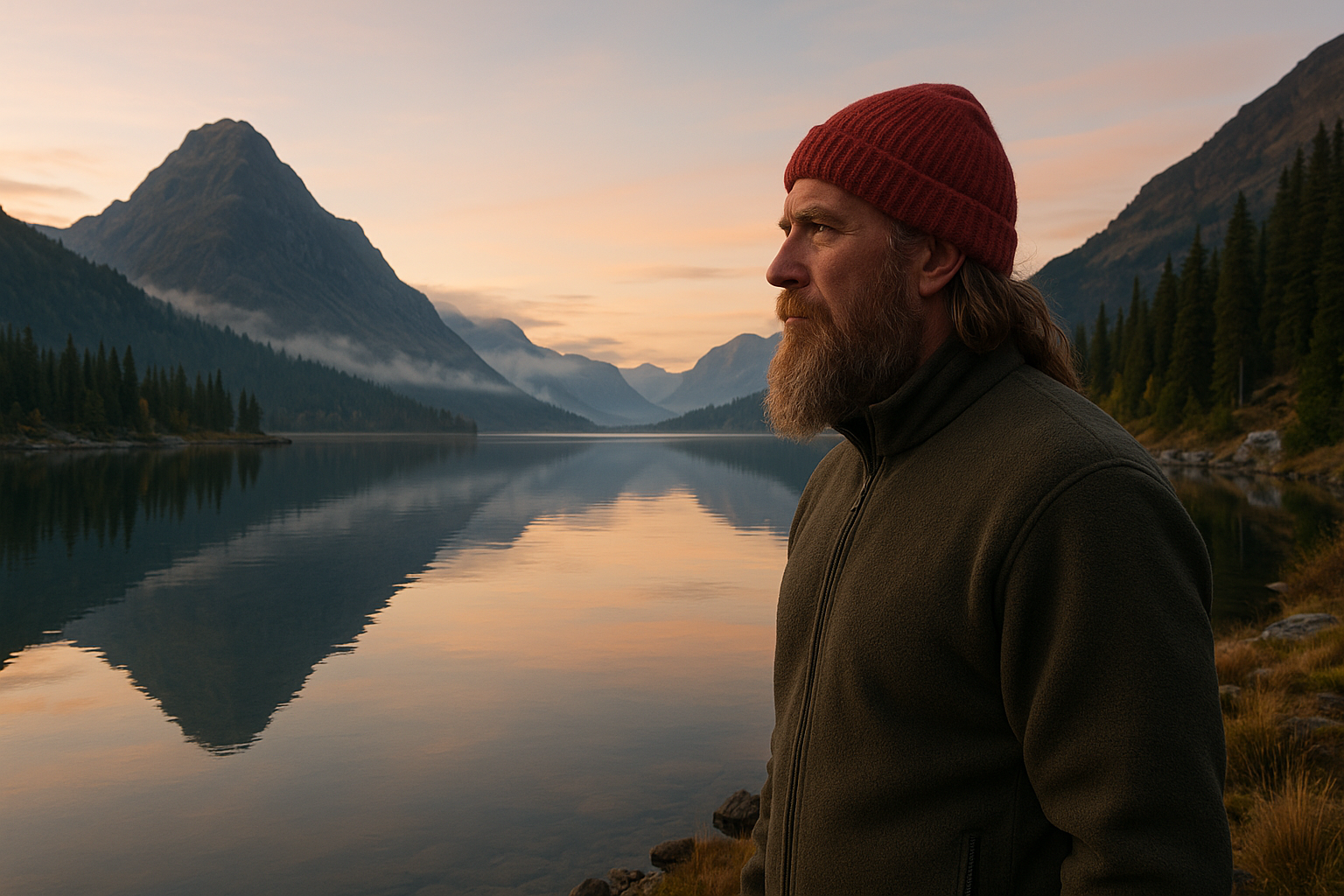
The Fire You Wear
By Odin Tu
The wind has a voice out here, one that changes shape as it travels through the trees. At night it speaks in long, hollow vowels, echoing across frozen rivers and cliffs of snow. By dawn it becomes something gentler, like a low chant that hums against the ribs. I have lived many winters with this sound as my companion, and it has taught me that fire is not only what burns in a stove or a pit. It also burns in the chest, beneath the layers, behind the breath. The cold does not kill what it cannot touch, and what it cannot touch is this hidden flame.
I began this journey in late winter when the sun had forgotten its full path and the sky was made of glass. I wanted to walk the ridges where the land folds like a sleeping animal and find a forgotten cabin marked only by an old map and a hunter’s tale. It was said to be built where three valleys meet, a place men once used as shelter when the northern wind was too proud to allow movement. I did not seek the cabin for comfort but for understanding. Every man who lives by endurance must now and then return to a place that reminds him why he endures at all.
For four days the world held its breath. The air stayed clear, the snow firm, the stars so close I could have believed they hung from invisible cords. The SASTA fleece stayed close to my body, holding the rhythm between sweat and skin, keeping the warmth where it belonged. I moved through the landscape like a small pulse inside a great frozen lung. My steps matched the heartbeat of the ground. Each pause, each breath, was a quiet exchange between body and weather.
The fifth morning arrived without warning. I woke to the sound of snow whispering against the canvas, a soft hiss that told of change. The light through the tent was flat, without depth. The storm had come early. I broke camp before the horizon could decide what color to be. The first hour was manageable, the snow fine and dry, but soon it began to thicken, filling the air until the world became one white sound. Wind pressed against my back with a weight that made thought difficult.
I tightened the straps, lowered my head, and moved. The fleece beneath my shell breathed like a second set of lungs. It absorbed effort, exhaled moisture, kept me steady. When the wind howled loud enough to make the teeth chatter, the jacket became the calm between storms. I thought of how fire behaves inside a forge; contained, deliberate, silent beneath the roar. The warmth under the fabric was just like that: a steady burn fed by muscle and will.
After hours of walking, I lost all sense of direction. My compass was a trembling needle, my mind a slower one. I followed the terrain by instinct and ended up descending into a shallow valley that offered some mercy from the wind. The snow had carved dunes as high as a man’s chest. I pushed through them one at a time until I reached a small hollow framed by black spruce. The storm circled above like a vulture but did not descend into the hollow.
I cleared a space with my boots, unrolled the tarp, and sat down. The cold moved fast when I stopped. I could feel it test the edges of my sleeves, searching for an opening. I pulled the fleece tighter around my throat, cinched the cuffs, and closed my eyes. There was a rhythm in the pulse of heat against my core. The body was a fire, and the jacket was its hearth. Without that bond, the flame would have scattered into the snow like sparks.
It is strange what you begin to think about when the cold starts asking questions. I remembered the first time I learned to start a fire without matches. My teacher was an old man who smelled of resin and smoke. He had said that flame is never created; it is only revealed. “The heat is already there,” he told me. “You only show it how to breathe.” As I sat in that hollow, I realized the same was true for the warmth inside me. The jacket did not create it. It only showed it how to live.
I stayed there for half a day, letting the storm burn itself out. The snow covered everything except my small circle of survival. When I finally stood again, the world had changed. The trees looked sculpted rather than alive. The air shimmered with a strange clarity that only follows violence. I walked until I found a ridge that looked down on a frozen river and set camp there for the night.
That evening I built a small fire. It was not to cook or to warm, but to watch. Fire has moods, and you learn them by studying its face. The flames moved with the same rhythm I felt beneath my jacket. Each flicker matched the beat of blood. I could see my breath join the smoke as it rose into the dark. That was when the revelation came, slow but firm. Fire is not an element. It is a relationship. The fleece I wore, the muscles beneath it, the air I exhaled: all of them were part of the same equation. I had carried this truth for years without naming it. Now it spoke its name in silence.
The next morning the sky opened wide again, and I continued toward the cabin. The snow had softened but carried my weight well enough. The landscape felt like the inside of an hourglass. Time moved slow, every sound exaggerated by the stillness that follows a storm. I crossed the frozen river, climbed the far bank, and entered a field of dwarf birch no taller than my knee. The air shimmered faintly with cold light. I could hear my heartbeat louder than the world.
By afternoon, I saw a shape ahead; a dark line at the base of the hill, half-buried but unmistakable. The cabin waited exactly where the old map had promised, as if time had forgotten to erase it. The roof sagged under snow, but the walls stood firm. I brushed the drift from the door and pushed. The hinges protested but yielded. Inside was a room no larger than a breath. A small stove, a cot, a wooden bench, and a window half-frosted by the years.
I built a fire in the stove and waited. The room filled with light that felt alive, not borrowed. I removed my outer shell but kept the fleece. I wanted to see how long I could hold my own warmth before the stove took over. The answer surprised me. The jacket carried me all the way through the fire’s first songs. I sat there, steam rising from my shoulders, the air inside the cabin turning soft and forgiving.
When the heat became too heavy, I stepped outside. The sky was a cathedral of light. The storm had swept away every trace of haze, leaving only stars sharp enough to cut. The cold met me with the authority of a king, but I no longer feared it. The fleece kept the fire alive, that same quiet pulse, that same discipline of heat. I realized then that the true purpose of good gear is not to protect you from nature. It is to remind you that you belong to it.
I thought about all the fires I had built in my life: on mountains, beside rivers, in places where wood was too wet and my hands too stiff. Every one of them had taught me something about patience and precision. But this fire; the one under my skin, the one this jacket kept safe: was different. It required no spark, no tinder, no windbreak. It asked only that I keep moving, breathing, believing. The fleece did not hold the heat for me. It held it with me.
The cabin became a kind of temple. Each day I stepped outside to walk the perimeter, to test the cold, to feel the wind’s verdict on my preparation. Each night I returned, shed my layers, and studied how warmth behaves when left alone. It is a living creature. Too much insulation and it suffocates. Too little and it flees. The balance is the lesson. The fleece seemed to understand it better than I did.
After three days the weather shifted again. I could feel it before I saw it; the air thickening, the light bending differently through the sky. A deep hum rolled through the distance, a sound that felt like a warning. I gathered my gear and decided to head south before the next storm claimed the land.
Half a day into my return, the wind returned as well. It came from the northwest this time, heavy with the scent of ice. I could see clouds boiling on the horizon, a wall of white moving fast. I stopped at a small clearing where the snow lay shallow and the trees offered poor cover. I could have built a fire, but something in me wanted to face the cold as it was. I wanted to test the revelation, to know if I could carry that inner flame without help.
The storm hit like a wave breaking over rock. The first gusts tore at the straps of my pack, tried to peel away the hood. I crouched low and turned my back to it. The snow came sideways, fast enough to sting. I closed my eyes and focused on breath. The fleece moved with me, a steady rhythm of warmth and response. I could feel the cold trying to claim the surface, but the heat beneath it stayed calm, like a candle in a closed hand.
I stayed that way for what must have been an hour, though time in a storm is a liar. When I opened my eyes, the world had disappeared into one endless white. But I was not cold. I was alive in a way that felt absolute. The jacket clung to me not as protection but as promise. I stood, leaned into the wind, and began walking again, one step at a time.
The path became philosophy. The deeper the cold pressed, the more I felt the fire rise to meet it. The line between body and world blurred. The jacket became a second skin, the cold became a teacher, and I became the spark that refused to go out. I understood then what it means to wear fire. It is not about comfort or survival. It is about reverence. You do not fight the cold. You honor it by bringing your own light to the meeting.
When the storm broke, the sky behind it turned the color of ash. I found shelter beneath a bluff where snow had packed into a smooth wall. I dug a hollow large enough for myself and sat there breathing, the fleece still warm, the body still burning. There was no need for a campfire. I had become one.
Night came slow. The air lost its sound. The stars returned, cautious at first, then bold. I sat there in that silence, wrapped in warmth that had no flame, and felt something close to worship. The cold was no longer my opponent. It was my reflection. The fire I wore did not defy it. It completed it.
I stayed under that bluff until morning. When the sun finally rose, it did so without drama, just a pale gold line across the snow. I stood, stretched my arms, and felt the warmth move through me like a tide. The fleece had dried overnight without stiffness or smell. It had taken the lesson of the night and folded it into its fibers.
I walked until I saw the first sign of trees heavy with frost. The storm had ended its hunt. The land lay calm again, vast and white, unbothered by my passage. I reached the frozen river where my tracks from days before had almost vanished. The only proof of my existence was the warmth that still pulsed beneath the layers. I smiled at that thought.
Before crossing back into the forest, I stopped and unzipped the jacket just enough to let the cold kiss my chest. It was sharp but not cruel. It reminded me of balance; the eternal negotiation between heat and frost, between motion and rest, between man and the world that made him.
The cabin was far behind me now, but its lesson stayed. Fire is not what burns. It is what remains after the burning ends. The fleece carried that truth, thread by thread, stitch by stitch. Each fiber held a small piece of the North’s patience. It had learned from stillness, from silence, from snow. It had become a teacher in its own right.
As I descended into the valley, I could see smoke from a distant chimney. Civilization, small and faint, like a rumor of warmth carried on the wind. I knew I would return to it eventually, but I also knew something else: I would never again think of warmth as something to seek. I already carried it. I wore it.
The body, the breath, the cloth: all of it part of the same ancient conversation. Fire was never a gift from the gods. It was a mirror. It shows you what you already hold.
I reached the forest edge and turned back once more. The ridge I had crossed looked peaceful now, its violence erased. The snow glittered where sunlight caught the grains. I touched the sleeve of the fleece and whispered a wordless thanks.
The wind moved through the trees with that same old voice, deep and knowing. It carried my breath away, mixed it with the cold, and gave it back as mist. I smiled and stepped forward into the trees, the flame steady, the lesson complete.